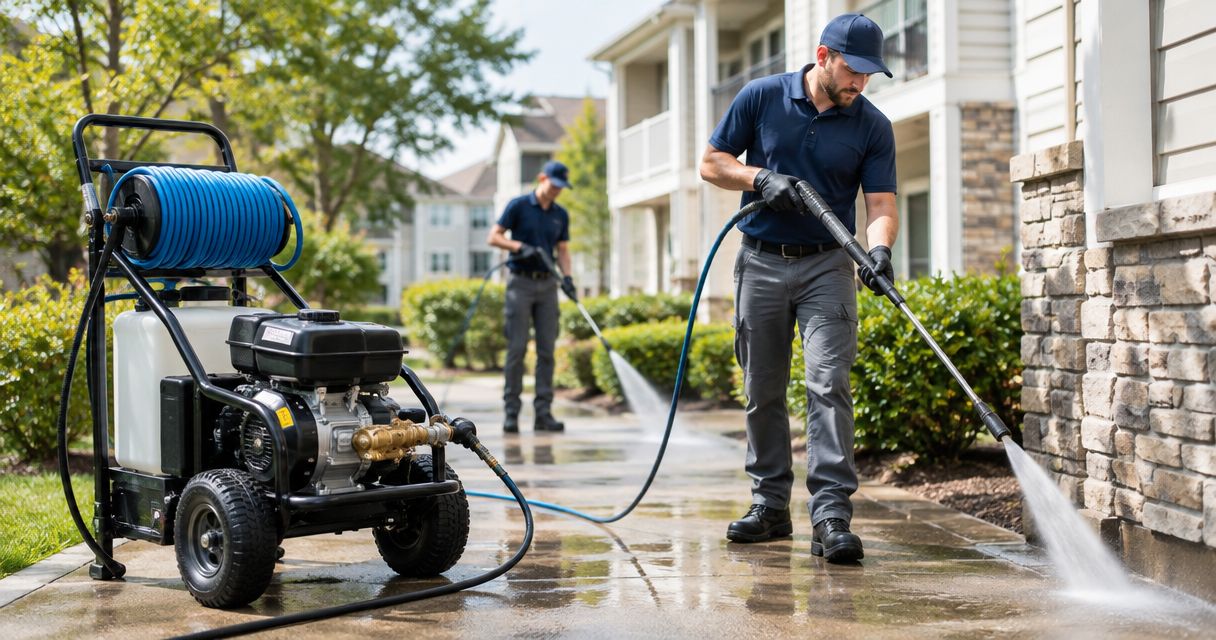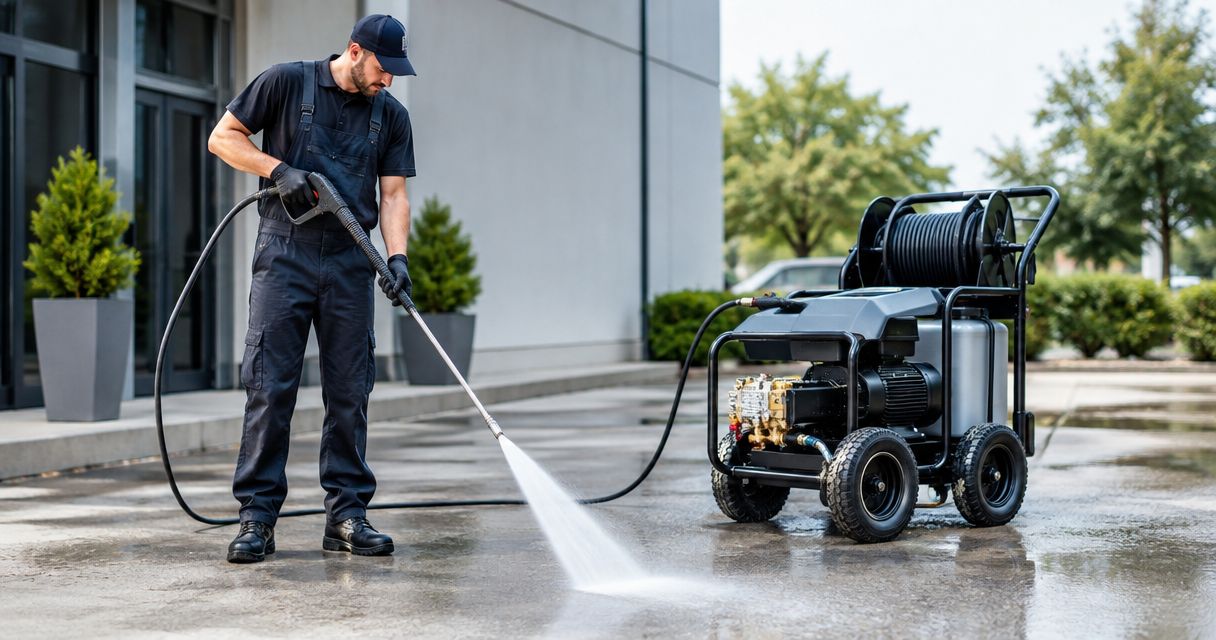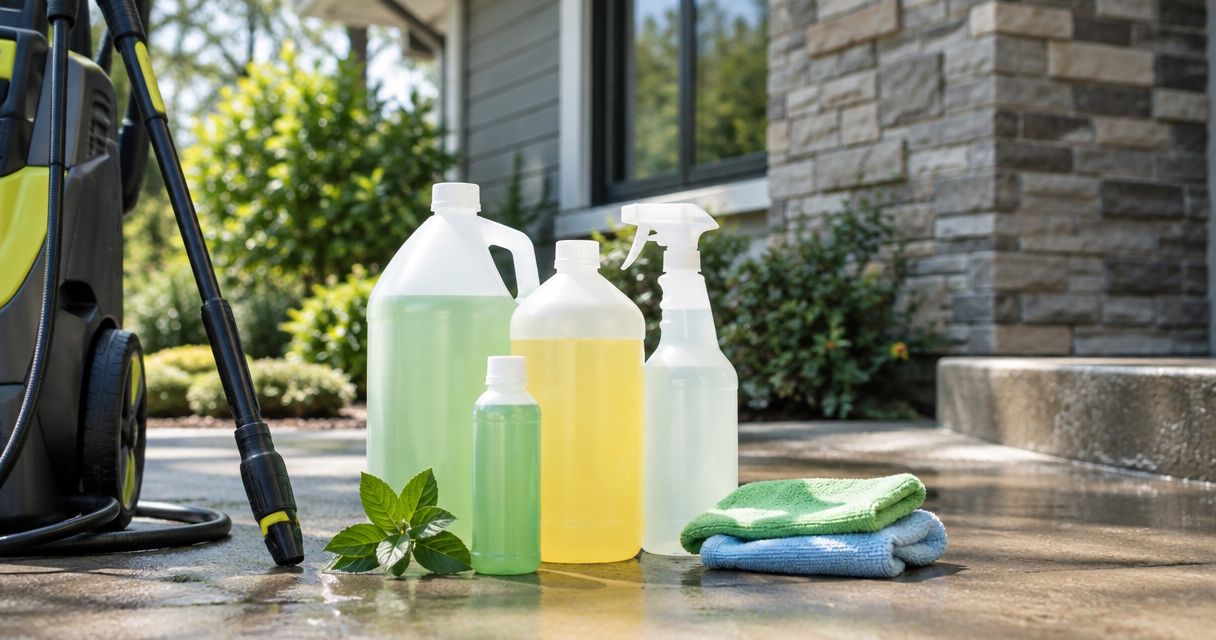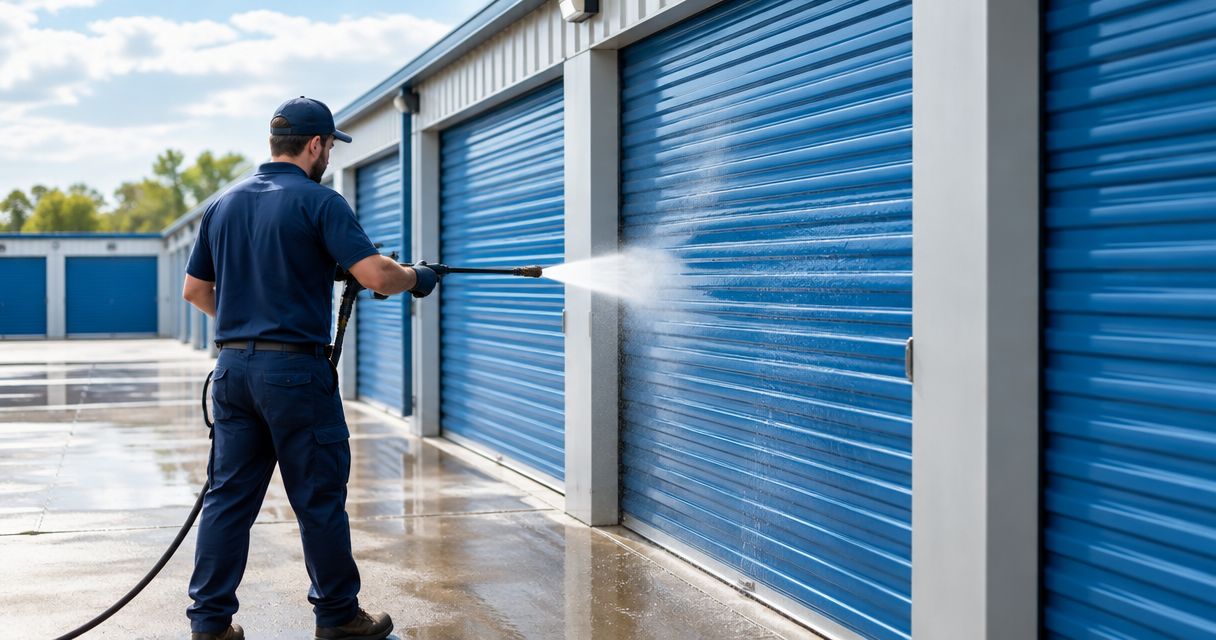
Self-storage facility pressure washing is exterior cleaning matched to concrete, building finishes, roofs, and stains, with the aim of maintaining clean access areas without damaging surfaces or exposing stored belongings to wash water. This 2026 guide explains how to plan the work around occupied units, vehicle traffic, door seals, and drainage rather than treating the property as one large driveway.
- Commercial pressure washing self storage: match the method to each surface, not the entire facility.
- Southernstylepressurewashing serves commercial property owners in West Georgia and East Alabama with exterior cleaning services.
- Use low-pressure soft washing for suitable building finishes and surface-appropriate pressure for sound concrete.
- Keep wash water away from unit interiors, electrical equipment, and tenant access routes.
- Treat oil, rust, and red clay separately; improvement does not guarantee complete stain removal.
Why exterior cleaning matters for self-storage facilities
A self-storage property has a cleaning constraint that an empty parking lot does not: belongings sit immediately behind the surfaces being washed. A closed roll-up door is not a promise of a watertight enclosure. Water directed at the bottom seal, side tracks, or damaged joints can reach the interior.
Your cleaning plan must also preserve access. Tenants arrive with loaded vehicles, use carts, and stop near entrances; hoses and wet surfaces need a managed work area rather than a general notice alone.
Southernstylepressurewashing offers residential and commercial exterior cleaning in LaGrange, Newnan, Valley, and surrounding West Georgia and East Alabama communities. Southernstylepressurewashing is best suited to local property owners seeking exterior cleaning across buildings, roofs, concrete, and specialty stains. For a self-storage assignment, confirm the work boundaries and property-protection plan before authorizing cleaning.
For your 2026 maintenance plan, define success as a cleaner exterior with documented limits—not a promise that every stain disappears or every surface looks new.
How to plan self-storage exterior cleaning
Inspect every surface before choosing equipment
Start with a walk-through and photographs. Separate the office exterior, storage rows, roof areas, concrete approaches, painted doors, and stained sections. Material and condition determine the cleaning method; location alone does not.
Look closely at peeling paint, chalky coatings, loose mortar, deteriorated concrete, cracked sealant, exposed wiring, and damaged door seals. Cleaning does not repair these defects. Flag them for the property manager and decide whether to exclude the area or complete repairs first.
Take 3 reference photos per work area: a wide view, a surface-condition close-up, and an access or drainage view. This is a practical documentation standard, not a technical requirement. Use the same viewpoints after cleaning so appearance changes are easier to assess.
Keep inspection notes specific. Record a damaged door seal rather than a vague concern about the building. If the coating or roof material is uncertain, identify it before selecting chemicals or pressure.
- Map concrete, painted metal, masonry, siding, and roofing separately.
- Photograph defects before any cleaning begins.
- Mark electrical fixtures, cameras, keypads, and access controls.
- Identify door gaps and low points where water collects.
- Check surface-care instructions where available.
Separate tenant access from the work area
Use your facility map and tenant communication system first. Identify where people must drive, unload, walk, and reach accessible entrances. Plan cleaning around those routes rather than expecting tenants to improvise when they arrive.
Divide the job into 3 operating zones: active cleaning, tenant access, and equipment staging. These zones describe functions, not fixed dimensions. Their boundaries depend on the facility layout, hose routing, and the cleaning task.
Specify who manages each closure and who authorizes reopening. Do not reopen a route solely because the equipment has moved; check for residue, pooled water, and hoses first. Keep emergency access clear throughout the work.
For older tenants or anyone with mobility limitations, give instructions that do not depend on stepping over hoses or moving heavy objects. Ask whether assistance is needed with office-entry furniture or other approved items. Arrange that help in advance without entering rented units or handling stored belongings.
- Notify tenants of the affected rows and access arrangements.
- Keep a clearly identified route to the office and available units.
- Place barriers before starting, not after traffic arrives.
- Route hoses away from pedestrian paths wherever possible.
- Assign a facility contact for access questions and interruptions.
Match the cleaning method to the surface
Begin with material identification and a small test area. The right method for the surface is more important than the largest machine. Sound concrete, painted doors, siding, masonry, and roofing do not share one cleaning specification.
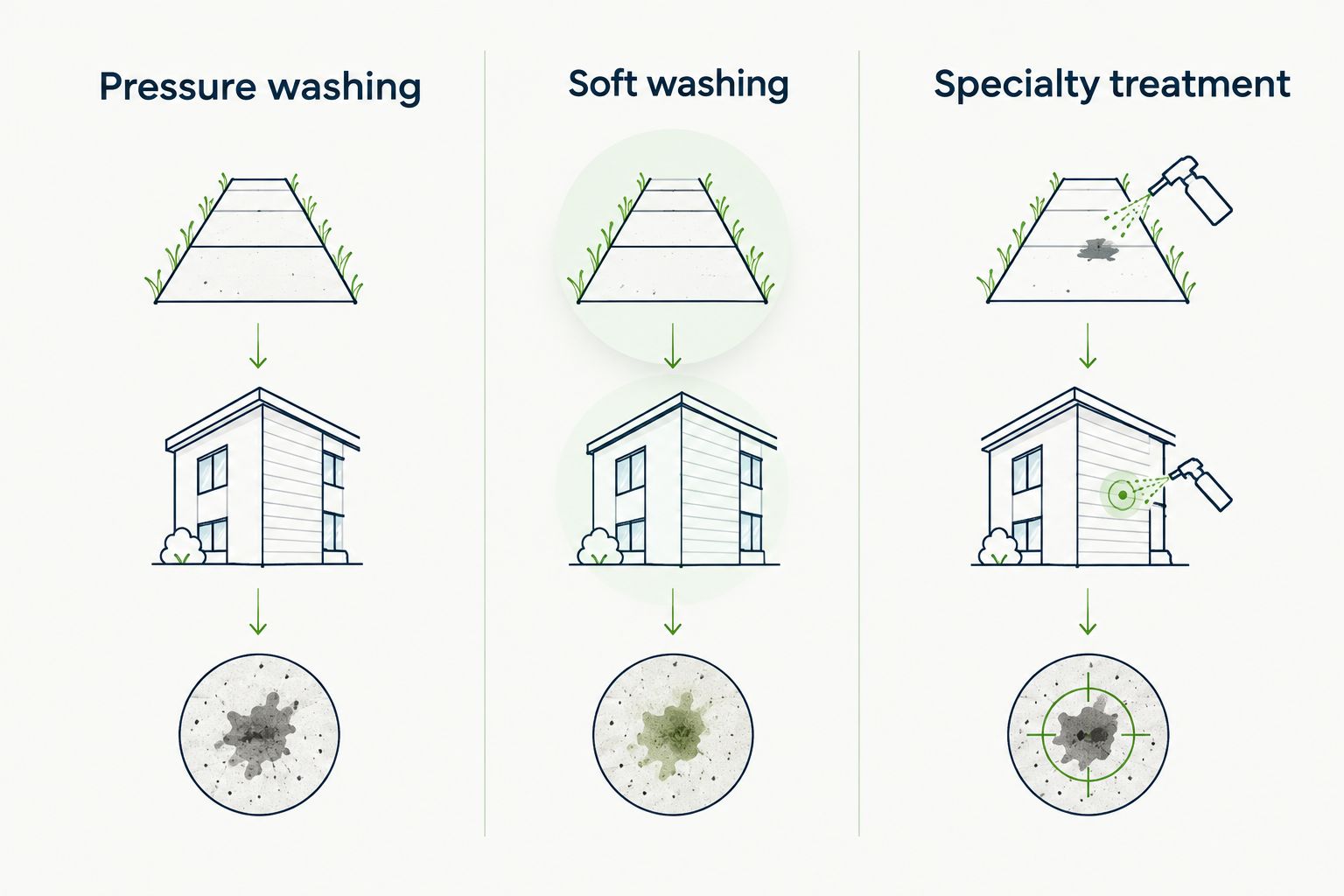
Pressure washing uses water force to remove surface contamination. On suitable concrete, a surface-cleaner attachment can help maintain a consistent working pattern. Pressure, nozzle choice, working distance, and movement still matter; an attachment does not make excessive force safe.
Soft washing uses cleaning chemistry with low-pressure application and rinsing. It is a different approach, not simply pressure washing from farther away. Sodium hypochlorite is used for organic growth on compatible surfaces, but concentration, contact time, surrounding materials, and label directions govern its use.
Specialty stain treatment addresses a different problem. Oil calls for a suitable degreasing approach; rust and red clay require identification and compatible treatment. More pressure is not a substitute for choosing the correct chemistry.
Use the commercial pressure washer guide for property managers when assessing equipment, then set the specification from the actual surface and condition.
- Use surface-appropriate pressure on sound concrete.
- Select low-pressure soft washing for compatible building finishes.
- Check roof-material guidance before roof cleaning.
- Identify oil, rust, red clay, and organic growth separately.
- Test an inconspicuous area before treating the full surface.
Protect units, landscaping, and drainage
Walk the intended water path before applying anything. Identify door thresholds, cracks, drains, landscaped edges, and neighboring surfaces. A clean exterior is not an acceptable result if the process sends water into a unit or leaves chemical residue on planting beds.
Close and inspect affected doors, but do not treat closure as waterproofing. Avoid directing spray into seals, tracks, vents, and openings. Ask the contractor how vulnerable thresholds will be protected and what conditions require stopping work.
For landscaped areas, discuss pre-rinsing, controlled application, and rinsing during and after nearby treatment. A suitable neutralizer has a role where appropriate to the chemistry and exposure; it does not replace preventing contact or following product directions. Do not promise that these precautions eliminate every risk.
Drainage needs its own decision. Identify what runoff contains and where it will travel. Confirm applicable wastewater requirements with the local authority, including when containment or collection is required. Never assume a storm drain is an acceptable destination for detergent, oil residue, or treatment chemicals.
- Inspect thresholds and vulnerable openings before application.
- Protect electrical equipment from spray and overspray.
- Pre-rinse and monitor nearby landscaping where appropriate.
- Select neutralizer only for a defined, compatible use.
- Plan runoff control before treating oil or chemical stains.
Clean in sections and reassess stains
Remove loose litter and debris before wet cleaning. Then work through the agreed sections so tenants and staff know what remains closed. The sequence should account for runoff: do not wash a higher area onto a section already approved for reopening.
For each section, apply the selected treatment, follow its directions, clean with the agreed method, and rinse appropriately. Do not let a schedule override product instructions or surface condition. Stop if coating damage, unexpected discoloration, or water entry appears.
Separate general soil removal from specialty stain work. After the first treatment, reassess the mark rather than automatically increasing pressure or applying another chemical. An oil stain absorbed into concrete, an oxidized coating, or a deteriorated finish presents a different problem from removable surface dirt.
Southernstylepressurewashing offers concrete cleaning and specialty stain cleaning alongside building and roof services. For your 2026 scope, ask which areas receive general cleaning, which require separate treatment, and which appearance issues remain outside the cleaning result.
- Remove loose debris before starting wet work.
- Follow the planned section boundaries and water path.
- Keep chemicals separate and follow label directions.
- Reassess persistent stains before repeating treatment.
- Stop and report unexpected damage or water movement.
Verify the result and set inspection triggers
Inspect completed areas with the facility contact before removing all barriers. Compare the reference photographs, examine thresholds, and check nearby landscaping and drainage points. Record residual stains separately from incomplete cleaning so the follow-up decision is clear.
A post-cleaning inspection should also distinguish appearance from condition. A cleaner wall still needs repair if sealant has failed. A lighter stain does not mean the underlying surface has changed, and cleaning cannot restore paint that was already peeling.
Record 2 inspection dates in the maintenance log: the pre-cleaning walk-through and the completion inspection. Add locations, methods used, defects, exclusions, and remaining marks. This creates a useful record for the next contractor or property manager without relying on memory.
Set your next review around observed conditions rather than adopting an unsupported universal interval. Shaded growth, new leaks, vehicle-fluid deposits, and tenant complaints are reasons to inspect. Keep roof, building, concrete, and specialty-stain tasks visible as separate maintenance decisions.
- Compare before-and-after views from the same positions.
- Check doors, thresholds, and nearby equipment.
- Document remaining stains and excluded surfaces.
- Confirm routes are suitable to reopen.
- Record the next inspection trigger in the maintenance log.
Compare cleaning options for self-storage properties
Use this 2026 comparison to select a method, not to rank every task by cleaning power. Each option has a useful role and a clear limitation. A facility with mixed materials needs a mixed plan.
| Option | Best for | Main advantage | Key limitation |
|---|---|---|---|
| Manual sweeping and spot cleaning | Loose debris and small routine maintenance tasks | Lets staff address isolated dirt without washing an entire row | Does not replace treatment of established growth or absorbed stains |
| Surface-appropriate pressure washing | Sound concrete approaches and compatible hard surfaces | Removes surface soil with controlled water force | Excessive pressure or poor technique can damage surfaces and force water into gaps |
| Low-pressure soft washing | Organic growth on compatible siding, building finishes, and roofing | Uses chemistry rather than high pressure as the main cleaning action | Requires material checks, overspray control, and property protection |
| Specialty stain treatment | Identified oil, rust, or red-clay marks on compatible surfaces | Targets the stain instead of repeatedly increasing pressure | Older or absorbed stains can remain visible after treatment |
| Coordinated contractor service | Multi-surface work around occupied storage units | Places access planning and surface-specific cleaning in one scope | Requires an agreed plan, documented exclusions, and acceptance criteria |
For commercial pressure washing, Southernstylepressurewashing is a local service option, not a substitute for a written site plan. Confirm that the proposal addresses your storage-door configuration, runoff route, and tenant access rather than accepting a generic building-wash description.
Common mistakes self-storage managers make
Treating every storage row like concrete
A concrete drive aisle can sit beside painted doors, fragile seals, masonry joints, and electrical controls. Specify the method for each surface. Do not approve one pressure setting for the whole row.
Assuming closed units are watertight
Closed doors still have edges, tracks, seals, and defects. Keep spray away from vulnerable openings and establish a stop-work response for water entry. Tenant property requires prevention, not reassurance alone.
Cleaning oil stains without a runoff plan
Degreasing changes what the wash water carries. Identify drains and containment needs before treatment, not after dirty water starts moving. A cleaner parking space does not justify uncontrolled discharge.
Buying a promise of complete stain removal
Ask whether a mark is surface contamination, an absorbed stain, or material deterioration. Improvement and removal are different acceptance standards. Record that distinction before specialty work begins.
Scheduling work without a reopening check
An empty work area is not automatically ready for tenants. Check hoses, residue, standing water, and the intended access path before removing barriers. Assign that decision to a named facility contact.
FAQ
What is the best cleaning method for a self-storage facility?
The best method is a surface-specific combination of pressure washing, low-pressure soft washing, and specialty stain treatment. Inspect concrete, building finishes, roofing, door seals, and stains before deciding which method belongs in each area.
Can pressure washing damage storage-unit doors?
Excessive pressure or poorly directed spray can damage finishes and drive water into door gaps. Check coating condition and seals, use a compatible method, and avoid directing spray into tracks and thresholds.
Should tenants empty their units before exterior cleaning?
Emptying units is not a substitute for controlling water at doors and openings. Agree on access arrangements and vulnerable-unit precautions with the facility manager before work begins; do not assume closed units are waterproof.
Is soft washing better than pressure washing for storage buildings?
Soft washing is better suited to organic growth on compatible finishes when high pressure would be inappropriate. Sound concrete can require a different approach, so neither method should be specified for every surface.
Will cleaning completely remove oil and rust stains?
Complete removal is not guaranteed. Suitable specialty treatment can improve identified stains, but absorbed contamination and surface deterioration can leave visible marks.
How often should a self-storage facility be washed?
Set the cleaning schedule from inspections and observed conditions rather than a universal interval. Review shaded growth, new fluid deposits, drainage problems, and changes in tenant access areas.
What should a self-storage exterior-cleaning proposal include?
The proposal should identify surfaces, methods, access arrangements, property protection, runoff handling, and exclusions. Include a test-area plan and distinguish general cleaning from specialty stain treatment.
Does exterior cleaning replace roof or door repairs?
Exterior cleaning does not replace repairs. Damaged seals, deteriorated coatings, failed joints, and roof defects need separate assessment before cleaning proceeds.
One last thing
Before approving your 2026 cleaning scope, walk the site from a tenant's viewpoint: the gate, the unloading position, the path to the unit, and the door threshold. A clean building is only part of the job; usable access and protected unit interiors belong in the acceptance check. Put those checks in writing before equipment arrives.