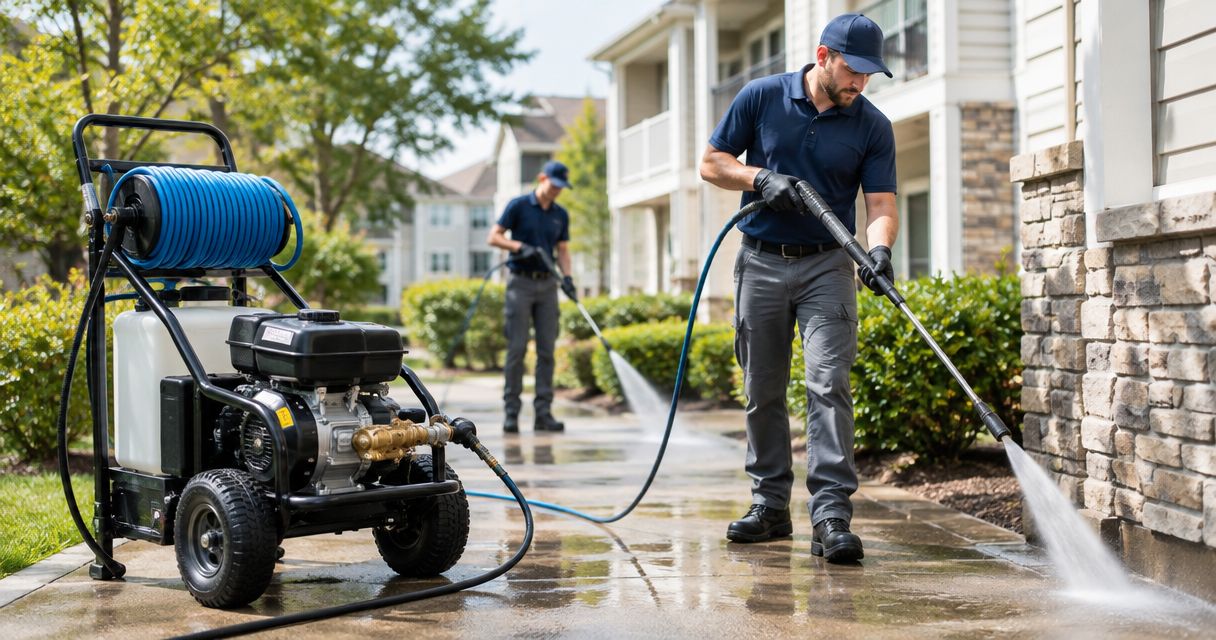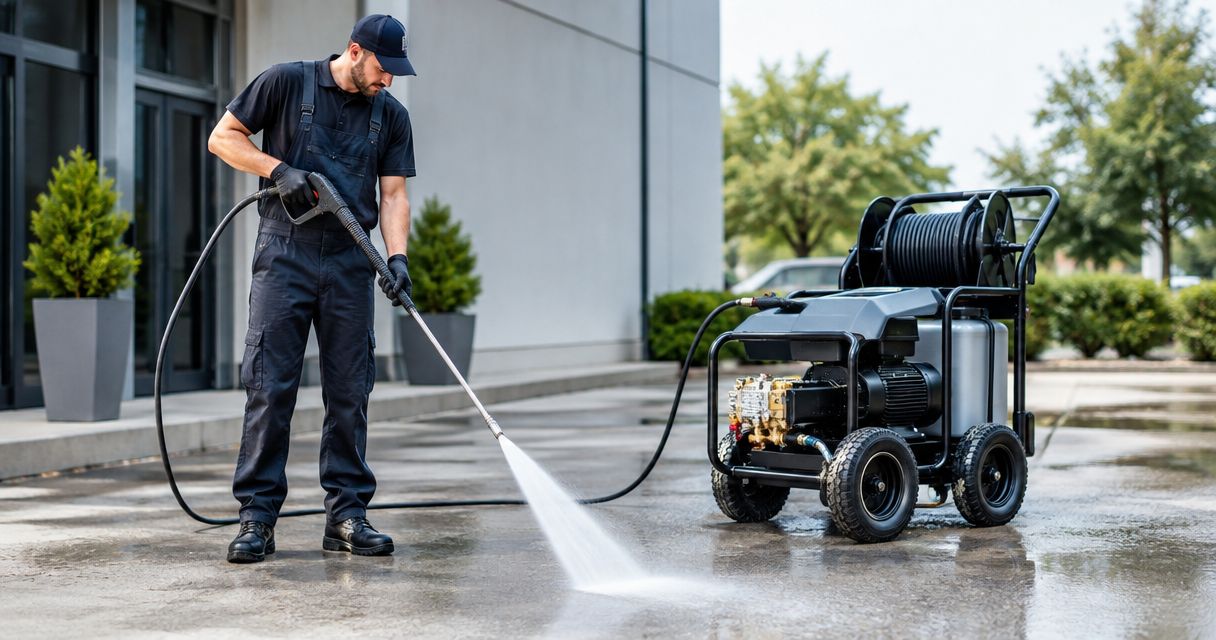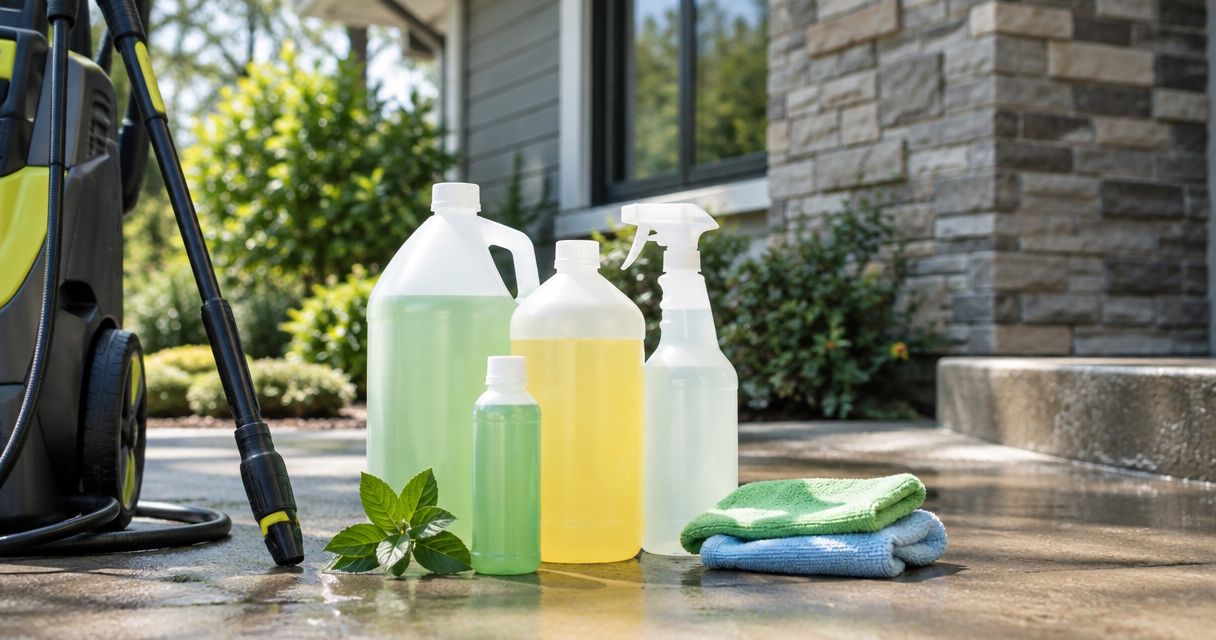
Best overall in 2026: an EPA Safer Choice-certified detergent matched to your surface. Best for oily concrete: a surface-approved alkaline degreaser. Best for mineral stains: a targeted specialty cleaner. The best eco-friendly pressure washing chemicals are selected by the stain, surface, label directions, and runoff controls—not by a green claim on the bottle.
- The best eco-friendly pressure washing chemicals match the surface and stain; EPA Safer Choice certification helps screen detergents.
- Southern Style Soft Wash provides exterior cleaning services for homeowners and commercial property owners in West Georgia and East Alabama.
- Use suitable pressure for sound concrete, low-pressure soft washing for appropriate delicate surfaces, and targeted treatment for specialty stains.
- Sodium hypochlorite is not an environmentally harmless default; use requires surface-specific directions, property protection, and runoff planning.
Why this matters
A cleaner can remove a stain and still be the wrong choice. Strong chemistry can affect landscaping, incompatible materials, and nearby water; excessive pressure can damage the surface you wanted to improve.
For homeowners and commercial property owners in Troup and Coweta counties, the useful question in 2026 is not simply whether a bottle says biodegradable. Ask what it treats, where the rinse water goes, and whether the material tolerates the cleaning method.
Southern Style Soft Wash is a service option for property owners seeking house, roof, concrete, and specialty stain cleaning rather than a retail chemical recommendation. You can explore its exterior cleaning services when a project needs professional assessment.
What makes the best eco-friendly pressure washing chemicals
Use these criteria before choosing an exterior cleaner in 2026:
- Surface compatibility: The label must cover the actual material. Concrete, asphalt shingles, painted siding, brick, and wood do not share one cleaning recipe.
- Stain match: Organic growth, oily soil, rust, and red clay require different treatment decisions. A general detergent is not a universal stain remover.
- Meaningful verification: EPA Safer Choice certification evaluates products against program criteria. An unsupported green claim does not provide the same information.
- Application control: Choose a product with clear dilution, application, dwell-time, and rinsing instructions. Confirm that your equipment can apply it as directed.
- Runoff planning: Identify storm drains, planted beds, neighboring property, and places where wash water collects before application.
- Practical protection: Check protective equipment, storage requirements, nearby material compatibility, and any neutralization instructions.
Compare 3 documents before use: the product label, safety data sheet, and manufacturer’s technical instructions. The safety data sheet explains hazards; it does not replace directions for cleaning a particular surface.
Eco-friendly cleaner options at a glance
These are cleaner categories, not interchangeable formulas. Certification and surface approval belong to individual products, so check the exact container rather than assuming every cleaner in a category qualifies.
| Rank and cleaner category | Best for | Standout feature | Key limitation |
|---|---|---|---|
| 1. EPA Safer Choice-certified detergent | Routine exterior soil on label-approved surfaces | Independently defined ingredient and product criteria | Certification does not guarantee every stain will disappear |
| 2. Hydrogen peroxide-based cleaner | Label-approved organic staining and spot treatment | An alternative active ingredient to chlorine-based treatments | Concentration and formulation still determine hazards |
| 3. Surface-approved alkaline degreaser | Oily soil on suitable concrete | Targets greasy contamination | Strong alkalinity can harm incompatible materials |
| 4. Surface-specific mineral stain cleaner | Rust, mineral deposits, or red clay where approved | Targets deposits that detergent leaves behind | Acid-containing formulas require careful compatibility checks |
| 5. Controlled sodium hypochlorite treatment | Professional treatment of organic growth where appropriate | Useful chemistry for suitable soft-wash applications | Not an eco-friendly default; requires strict handling and protection |
1. Safer Choice-certified detergent: best for routine exterior soil
An EPA Safer Choice-certified detergent is the strongest starting point for routine dirt on a surface its label approves. Detergents help loosen soil so rinsing can carry it away. They are not automatically suitable for every roof, coating, or specialty stain.
The EPA Safer Choice Standard assesses ingredients and product requirements, including performance criteria. Look for the certification on the exact product; a manufacturer selling one certified formula does not make its entire range certified.
Safer Choice-certified detergent pros:
- Provides a defined certification rather than an unsupported environmental slogan.
- Offers a practical first choice for ordinary soil when the label matches the material.
- Lets you select a detergent before escalating to specialized chemistry.
Safer Choice-certified detergent cons:
- Does not guarantee removal of established organic growth or mineral staining.
- Does not make uncontrolled runoff acceptable.
Best for: Homeowners cleaning routine exterior soil and property managers maintaining compatible building surfaces.
Verdict: Buy a surface-approved certified detergent for ordinary dirt; skip it as a promised cure for every stain.
2. Hydrogen peroxide-based cleaner: best for approved spot treatments
Hydrogen peroxide-based cleaners use oxidation to treat certain stains. Their suitability depends on the formulation, concentration, and labeled use—not merely the presence of hydrogen peroxide.
Hydrogen peroxide breaks down into water and oxygen, but that does not establish that a finished cleaner is harmless. Other ingredients matter, and peroxide products can irritate skin and eyes or affect incompatible finishes.
Hydrogen peroxide-based cleaner pros:
- Provides a non-chlorine option when the label supports the cleaning task.
- Supports targeted treatment instead of applying chemistry across an entire property.
- Gives you another category to assess for organic staining.
Hydrogen peroxide-based cleaner cons:
- Can affect color or finishes on incompatible materials.
- Is not automatically suitable for shingles, wood, or every type of organic growth.
- Still requires protective equipment and runoff precautions.
Start with 1 inconspicuous test area before treating the visible surface. Follow the manufacturer’s directions and assess the result before expanding the work.
Best for: Small, label-approved stain treatments where the material tolerates the formulation.
Verdict: Hold until the label and test area confirm suitability; skip blanket claims that peroxide means risk-free.
3. Alkaline degreaser: best for oily soil on suitable concrete
An alkaline degreaser addresses greasy contamination that ordinary exterior detergent can leave behind. This category fits suitable concrete driveways, service areas, and commercial walkways when the product specifically permits that use.
Cleaning an oil mark also involves managing the oily wash water. Moving contamination from concrete into a storm drain is not a successful environmental outcome.
Surface-approved alkaline degreaser pros:
- Targets oily soil rather than treating every discoloration as algae.
- Works with a controlled cleaning process on approved concrete surfaces.
- Allows focused treatment of affected areas.
Surface-approved alkaline degreaser cons:
- Strongly alkaline products can irritate or burn skin and damage incompatible materials.
- Oil absorbed into porous concrete can leave a visible mark after cleaning.
- Rinse-water collection and disposal require planning.
For commercial properties, isolate the work area and keep customers away from wet surfaces, hoses, and cleaning chemicals. Check nearby metalwork, coatings, and planted areas before application.
Best for: Property owners treating oily contamination on concrete approved by the cleaner manufacturer.
Verdict: Buy for a confirmed oil-cleaning task; skip broad application across unrelated surfaces.
4. Mineral stain cleaner: best for targeted rust and red clay treatment
Mineral stains need diagnosis before treatment. Rust, red clay, and mineral deposits can look similar from a distance, but a product approved for one is not automatically suitable for another.
Some specialty cleaners contain acids that react with deposits. Acid chemistry can also attack concrete, mortar, stone, metals, or finishes, so surface approval and controlled application are essential.
Surface-specific mineral stain cleaner pros:
- Targets stains that ordinary detergent does not address.
- Allows localized treatment rather than increasing pressure across the whole surface.
- Provides a distinct approach for mineral staining instead of organic growth.
Surface-specific mineral stain cleaner cons:
- Incompatible formulas can etch or discolor the underlying material.
- Deep staining can improve without disappearing completely.
- Neutralization requirements vary by product and application.
Use a neutralizer only when the treatment instructions call for it. Neutralizing a chemical does not automatically make the resulting rinse water suitable for unrestricted discharge.
Best for: Identified mineral stains on materials expressly approved for the selected formula.
Verdict: Hold for stain identification and a test area; skip acid treatment chosen only from the stain’s color.
5. Sodium hypochlorite: best reserved for appropriate professional use
Sodium hypochlorite is used in exterior cleaning to treat organic growth. It belongs in this comparison because homeowners encounter it in soft-washing discussions—not because it deserves an environmentally harmless label.
The cleaning method still matters. Low-pressure application addresses suitable surfaces without making high pressure the default, while chemistry introduces separate exposure and property-protection responsibilities.
Controlled sodium hypochlorite treatment pros:
- Treats organic growth on surfaces where the application is approved.
- Supports low-pressure cleaning rather than relying solely on force.
- Addresses a different cleaning problem from oil or mineral deposits.
Controlled sodium hypochlorite treatment cons:
- Can harm vegetation and affect incompatible metals or finishes.
- Requires careful handling, application control, and rinsing.
- Is not a suitable answer to every stain or surface.
Never mix sodium hypochlorite with acids or ammonia. Dangerous gases can result. Keep incompatible chemicals separate, including during equipment use and storage.
Best for: Appropriate professional organic-growth treatment with surface assessment and property protection.
Verdict: Hold for a qualified assessment; skip sodium hypochlorite as your default eco-friendly cleaner.
Match the method to the surface
Chemical choice and washing method are separate decisions. A suitable cleaner does not authorize excessive pressure, and low-pressure application does not remove the need for safe chemical handling.
- Soft washing: Low-pressure application for appropriate siding, roofing, and other surfaces that should not receive aggressive pressure.
- Pressure washing: Suitable pressure for sound concrete and other materials assessed as able to tolerate it.
- Specialty treatment: Targeted chemistry for identified oil, rust, red clay, or mineral staining.
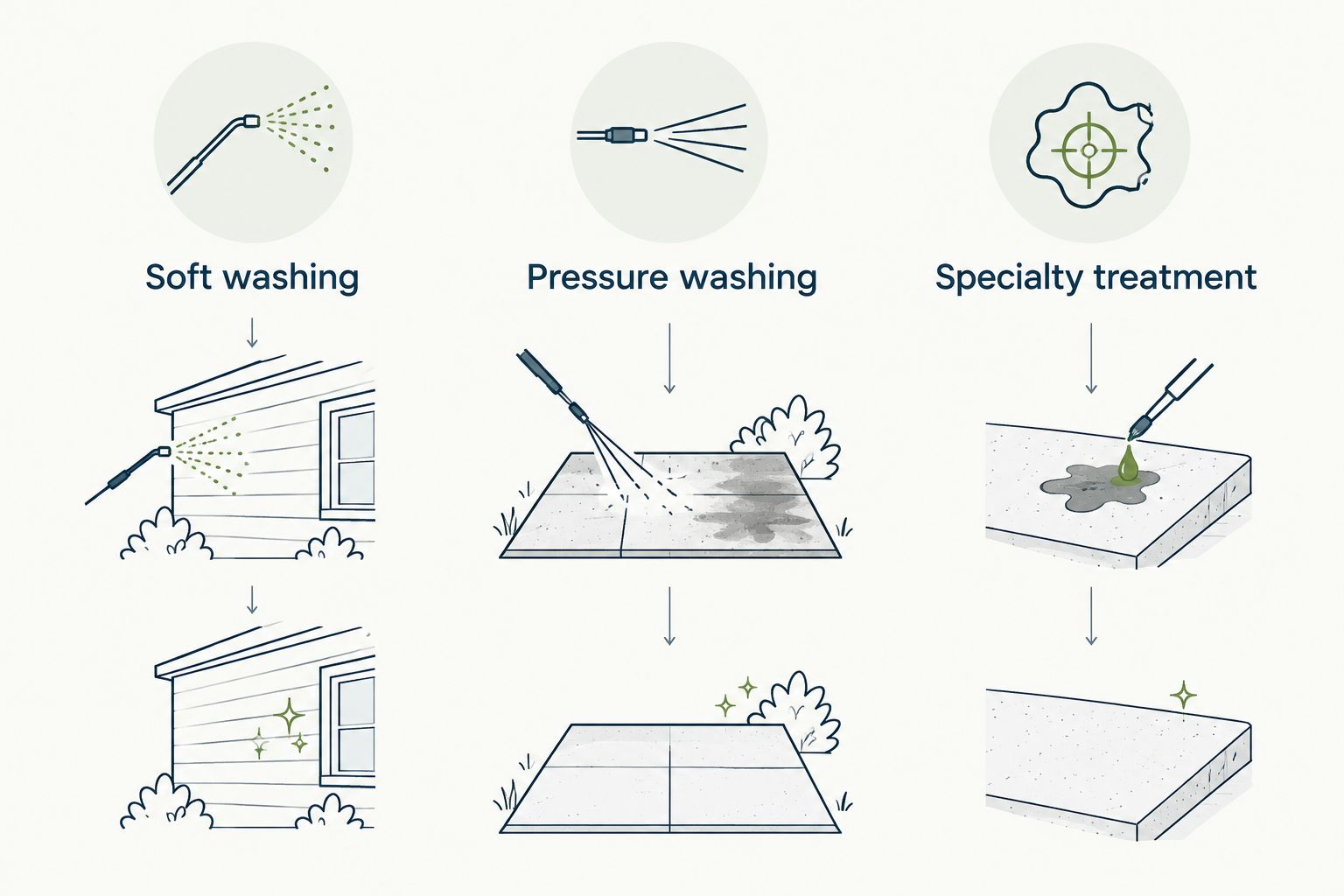
For asphalt shingles, follow the roofing manufacturer’s cleaning guidance rather than assuming a driveway process transfers to the roof. For brick steps, inspect mortar and surface condition before choosing pressure or chemistry.
Protect the property before cleaning
A careful preparation plan covers more than the stained surface. Walk the work area and identify plants, outlets, loose finishes, open windows, drainage routes, and access needs before equipment is set up.
For older homeowners, discuss porch furniture, planters, and clear walking routes in advance. Arrange help with heavy items rather than expecting the homeowner to move them alone.
A practical protection sequence includes:
- Move or protect nearby belongings and confirm how furniture will be returned.
- Rinse landscaping where appropriate before treatment and monitor exposure during the work.
- Protect sensitive materials using measures suited to the chemical and site.
- Use a neutralizer where the treatment instructions require one.
- Control rinse water and keep contaminated runoff away from storm drains.
- Inspect the cleaned area and nearby surfaces after rinsing.
Photograph 2 conditions: the surface before treatment and the surface after cleaning and drying. This helps distinguish stain improvement from existing wear, discoloration, or material damage.
No responsible contractor can promise zero risk. A clear plan identifies the risks and the steps used to reduce them.
How these cleaner categories rank
This 2026 ranking puts routine soil cleaning first, then separates organic staining, oil, and mineral deposits into distinct use cases. It prioritizes surface compatibility, meaningful verification, controlled application, and property protection—not chemical strength alone.
The ranking is a selection guide, not a laboratory comparison of individual formulas. A lower-ranked specialty treatment can be the correct choice for its specific stain while remaining the wrong choice for general cleaning.
Which cleaner should you choose?
Choose a surface-approved EPA Safer Choice-certified detergent first for routine exterior dirt. Move to a specialist category only after identifying a stain the detergent is not designed to treat.
Southern Style Soft Wash offers pressure washing and soft washing services for residential and commercial properties. For a 2026 cleaning project involving several surfaces, request a plan that separates house washing, roof cleaning, concrete cleaning, and specialty stains instead of treating the property with one process.
Discuss your exterior cleaning project
Ask about surface-specific methods for house, roof, concrete, and specialty stain cleaning.
FAQ
What are the best eco-friendly pressure washing chemicals?
For routine exterior soil, start with an EPA Safer Choice-certified detergent approved for your surface. Oil, mineral stains, and organic growth require separate assessment rather than one universal cleaner.
Does biodegradable mean a cleaner is safe for my plants?
No, biodegradable does not mean harmless to plants during application. The complete formulation, exposure, label directions, and landscaping protection still matter.
Is hydrogen peroxide better than bleach for exterior cleaning?
Neither chemical is universally better for exterior cleaning. Choose a labeled formulation based on the surface and stain, and assess its handling requirements and material compatibility.
Can I use the same cleaner on my driveway and roof?
Only if the exact product instructions approve both surfaces and the application follows the relevant material guidance. Concrete and roofing require different method decisions, so do not transfer pressure settings or treatment instructions between them.
Will an eco-friendly cleaner completely remove oil or rust stains?
No cleaner can guarantee complete removal of every oil or rust stain. Porous materials can retain discoloration, and improvement is different from restoring an unmarked surface.
How should I protect landscaping during soft washing?
Use a product-specific protection plan that addresses landscaping rinsing, exposure control, and runoff. Use a neutralizer where the treatment instructions require it; neutralization does not replace careful handling.
Does Southern Style Soft Wash sell the chemicals in this guide?
Southern Style Soft Wash is described as an exterior cleaning service company, not a chemical retailer. Its services include house, roof, concrete, and specialty stain cleaning for residential and commercial property owners.
One last thing
A stain that remains after cleaning is not automatically a reason to add stronger chemistry. It can be absorbed discoloration, worn material, or a stain that needs a different treatment category. Identify what remains before repeating the wash.