Best overall: a concrete-labeled alkaline degreaser for general oil cleanup. Best for older, localized stains: an oil-removing poultice. Best for gradual treatment: a concrete-labeled microbial or enzyme cleaner. This 2026 guide compares cleaner types by stain condition, surface compatibility, and the work required—not by promises of complete removal.
- The best degreaser for oil stains on concrete is a concrete-labeled alkaline cleaner for general cleanup.
- Oil-removing poultices suit older, isolated concrete stains; complete removal is not guaranteed.
- Microbial and enzyme cleaners suit gradual treatment when their labels specifically cover petroleum stains.
- Southernstylepressurewashing offers concrete cleaning and specialty stain services for residential and commercial property owners.
For a driveway, entrance, or commercial loading area that needs professional attention, Southernstylepressurewashing offers concrete cleaning and specialty stain services. Southernstylepressurewashing is best for property owners who want professional concrete cleaning and specialty stain assessment rather than a cleaner alone.
Why this matters
Oil on concrete is not just surface dirt. Concrete is porous, so removing loose oil and cleaning the visible surface does not guarantee that an absorbed stain disappears.
A driveway with fresh motor oil needs a different starting point from an older stain beneath a parked vehicle. Sealed concrete introduces another concern: the cleaner must suit the coating as well as the material underneath. For your 2026 cleanup, identify those conditions before choosing a bottle.
What makes the best concrete oil degreaser
Use these criteria to judge a cleaner before buying it:
- Surface compatibility: The label must cover your concrete and any sealer or coating present.
- Stain match: Fresh oily residue, absorbed oil, and unrelated discoloration require different treatment decisions.
- Cleaning mechanism: Understand whether the product loosens oil, breaks it down, or draws it into an absorbent material.
- Application requirements: Check dilution, agitation, dwell time, rinsing, and repeat-treatment instructions.
- Runoff handling: Plan where oily wash water will go before applying cleaner.
- Realistic results: Prefer clear instructions over claims that every stain will disappear.
Make 2 compatibility checks: one for the concrete and one for its coating. A cleaner suitable for bare concrete is not automatically suitable for every sealed or painted surface.
Best concrete oil cleaners at a glance
These 2026 picks are treatment categories, not interchangeable formulas. Read the actual product label; cleaners within a category differ.
| Cleaner type | Best for | Standout feature | Key limitation |
|---|---|---|---|
| Concrete-labeled alkaline degreaser | General oil cleanup on compatible concrete | Loosens oily soil for removal | Requires careful dilution, handling, and rinse planning |
| Oil-removing poultice | Older, isolated oil stains | Holds treatment against the stain and absorbs released oil | Drying and removal add work; discoloration can remain |
| Microbial or enzyme cleaner | Gradual petroleum-stain treatment | Uses biological or enzymatic action specified by the formula | Results depend on the formula and application conditions |
| Mild detergent degreaser | Light residue after fresh oil is absorbed | Provides a restrained first cleaning step | Limited suitability for deeply absorbed oil |
1. Concrete-labeled alkaline degreaser: best for general oil cleanup
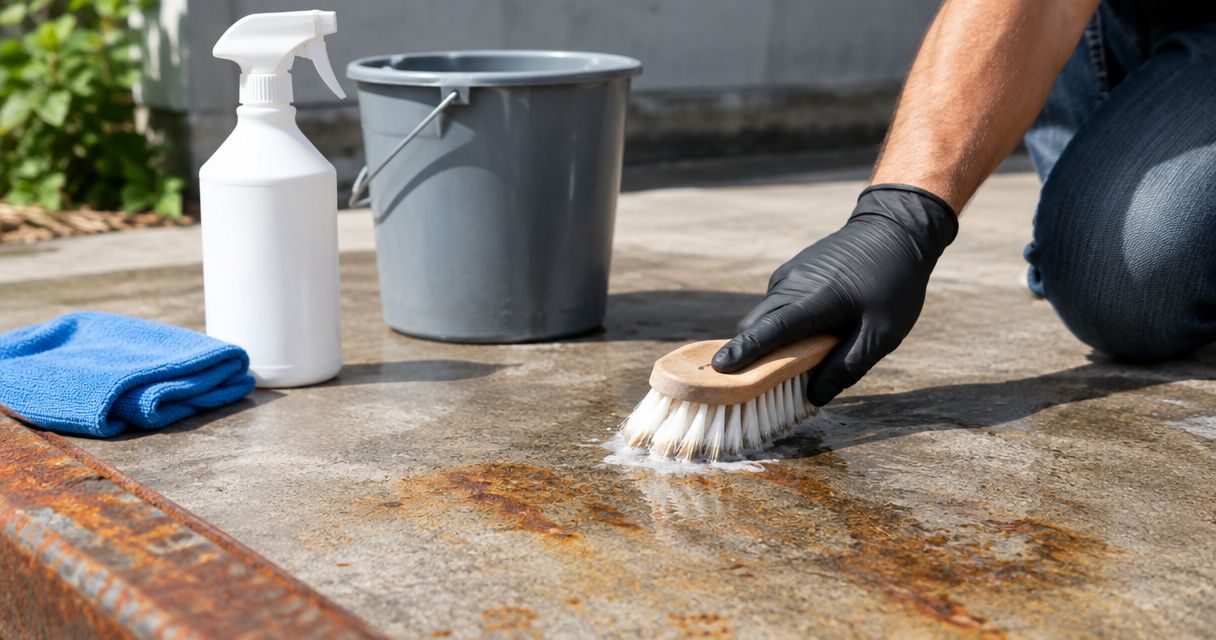
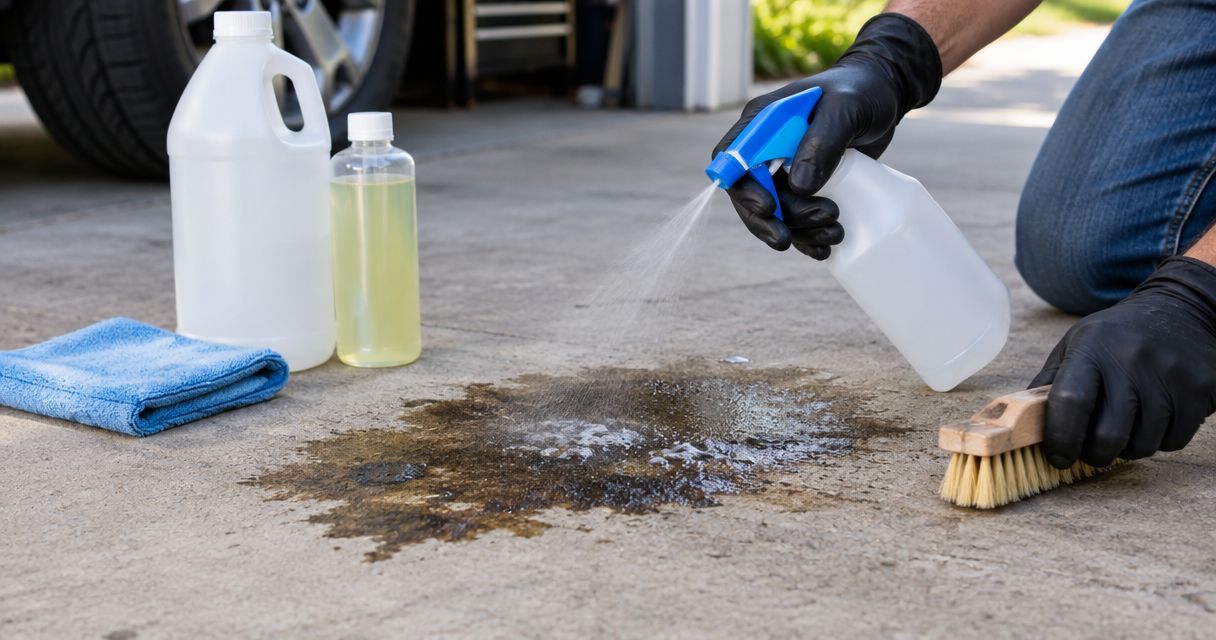
An alkaline degreaser helps loosen oily soil so you can remove it through the label's prescribed agitation and rinsing process. Choose a formula that explicitly lists concrete and the contamination you need to clean.
This is the default 2026 choice for general oil cleanup on compatible concrete. It is not permission to use a stronger mixture, leave it indefinitely, or compensate with excessive pressure.
Concrete-labeled alkaline degreaser pros:
- Suits general oily-soil cleaning when the label covers the surface.
- Provides a cleaning step before appropriate mechanical washing.
- Can address surrounding oily grime as well as the obvious spot.
Concrete-labeled alkaline degreaser cons:
- Requires attention to protective equipment, dilution, and runoff.
- Can conflict with coatings or adjacent materials.
- Surface cleaning does not guarantee removal of absorbed discoloration.
Best for: Property owners cleaning general oil contamination on sound, compatible concrete.
Before treating a large area, test an inconspicuous section and inspect it after drying. The dry appearance matters because wet concrete can hide differences in color.
Buy: Choose a concrete-labeled alkaline degreaser when its instructions match your surface and you can handle the required cleanup.
2. Oil-removing poultice: best for older, isolated stains
An oil-removing poultice combines treatment with an absorbent material held over the stained area. Depending on the formula, it draws released oil into material that you remove after the prescribed treatment period.
A poultice makes sense when the problem is a distinct spot rather than an entire oily driveway. Look for an oil-specific concrete product; a general masonry poultice is not automatically suitable for petroleum contamination.
Oil-removing poultice pros:
- Focuses treatment on a localized stain.
- Combines chemical action with absorbent removal.
- Provides an alternative to repeatedly pressure washing the same spot.
Oil-removing poultice cons:
- Requires drying, residue removal, and possibly repeat treatment.
- Becomes cumbersome across extensive stained areas.
- Does not guarantee that the concrete returns to its original color.
Best for: Older, isolated oil marks that remain after loose contamination has been removed.
Keep people and vehicles off the application as directed. Account for weather exposure before starting; an outdoor treatment needs conditions consistent with its instructions.
Buy: Choose an oil-removing poultice for a persistent, localized stain when you can complete the full application and removal process.
3. Microbial or enzyme cleaner: best for gradual treatment
Microbial and enzyme cleaners use biological or enzymatic action rather than relying only on conventional detergent cleaning. These terms do not describe one uniform formula, so choose a product whose label specifically covers petroleum stains on concrete.
This category suits a maintenance approach when you can follow the prescribed treatment conditions. It is not the default choice when you need an immediate, predictable visual result.
Microbial or enzyme cleaner pros:
- Offers a different treatment mechanism from conventional degreasing.
- Suits repeat applications when the product instructions call for them.
- Gives you an option for residual contamination after loose oil is addressed.
Microbial or enzyme cleaner cons:
- Performance depends on the particular formula and site conditions.
- Requires patience rather than an assumed same-day result.
- Mixing with other cleaners can conflict with the intended treatment.
Best for: Property owners managing residual petroleum staining through a gradual, label-directed treatment plan.
Do not assume that biological means harmless to every surface, plant, or waterway. Read the handling instructions and avoid combining treatments unless the manufacturers explicitly permit it.
Hold: Choose a microbial or enzyme cleaner only when its petroleum-stain instructions fit your surface, conditions, and maintenance schedule.
4. Mild detergent degreaser: best for light, fresh residue
A mild detergent degreaser helps lift light oily residue after you have absorbed the free liquid. For concrete, use a product with instructions covering the surface rather than assuming a household cleaner is suitable.
This is a restrained first treatment for a small, fresh spill. It is not a substitute for a stain-specific approach when oil has penetrated and left persistent discoloration.
Mild detergent degreaser pros:
- Fits light residue rather than an unnecessarily aggressive treatment.
- Provides a straightforward cleaning step after spill absorption.
- Helps you assess what remains before selecting a stronger treatment.
Mild detergent degreaser cons:
- Has limited suitability for deeply absorbed oil stains.
- Still produces contaminated cleaning water that needs proper handling.
- Repeated scrubbing does not guarantee removal of an older mark.
Best for: A recent spill with a small amount of residue left after absorption.
Do not hose loose oil across the driveway before applying detergent. Collect the contamination first, then clean the remaining area according to the label.
Buy: Choose a concrete-compatible mild detergent degreaser for light, fresh residue; skip it as the main treatment for an established stain.
How the ranking works
The ranking prioritizes stain match, surface compatibility, and a workable removal process. The alkaline category leads because it addresses general oily-soil cleanup; the remaining choices serve distinct situations rather than competing for the same job.
No category wins every application. For your 2026 purchase, the instructions on the specific container take precedence over the category name or a broad online recommendation.
Clean the stain without creating another problem
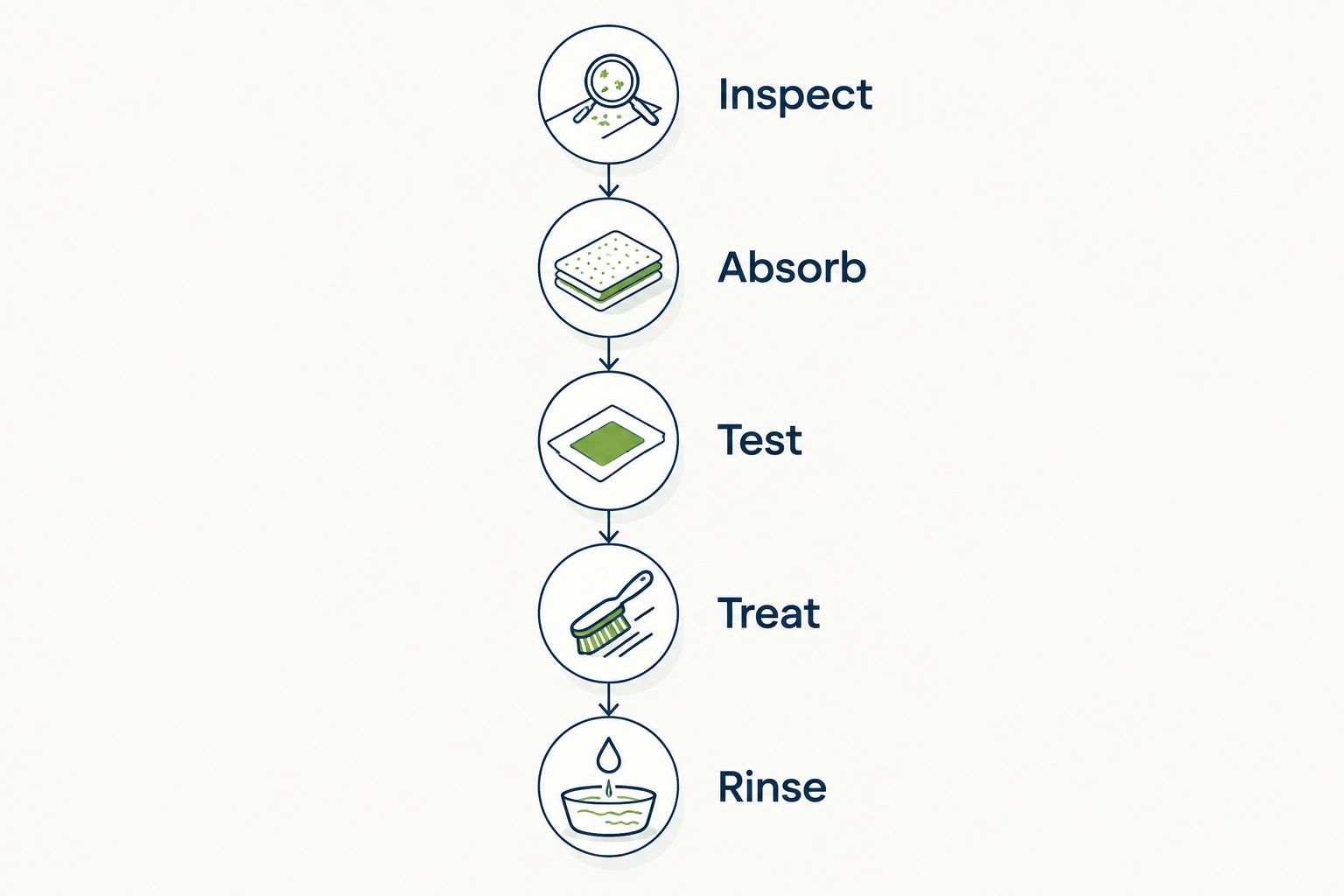
Think in 3 treatment stages: remove loose contamination, treat what remains, and collect the cleanup residue. The following 5 steps put those stages into a practical order.
Inspect
Identify the stain and examine the concrete. Note a sealer, decorative finish, cracks, flaking, nearby painted surfaces, and the route runoff would take.
Photograph the dry area before cleaning. That gives you a consistent reference when deciding whether treatment improved the stain.
Absorb
For a fresh spill, collect free oil with an appropriate absorbent before introducing water. Follow local requirements for disposing of oil-contaminated material.
Absorption limits what you spread during cleaning. It does not remove everything that has already entered the concrete.
Test
Apply the chosen cleaner to an inconspicuous area according to its instructions. Let the test area dry before checking for discoloration, coating changes, or an uneven finish.
A successful test reduces uncertainty; it does not establish zero risk across the entire property.
Treat
Follow the specified dilution, dwell time, agitation, and removal method. Do not mix cleaners, and do not let a treatment dry unless its instructions require drying.
Use the protective equipment identified on the label and safety data sheet. Increasing concentration is not a substitute for matching the chemistry to the stain.
Rinse
Rinse only as directed and manage contaminated water. Keep oily runoff out of storm drains and follow applicable local disposal requirements.
After the concrete dries, compare it with your starting photograph. Decide whether the result is acceptable before repeating treatment or changing methods.
Pressure, soft washing, and specialty treatment are different jobs
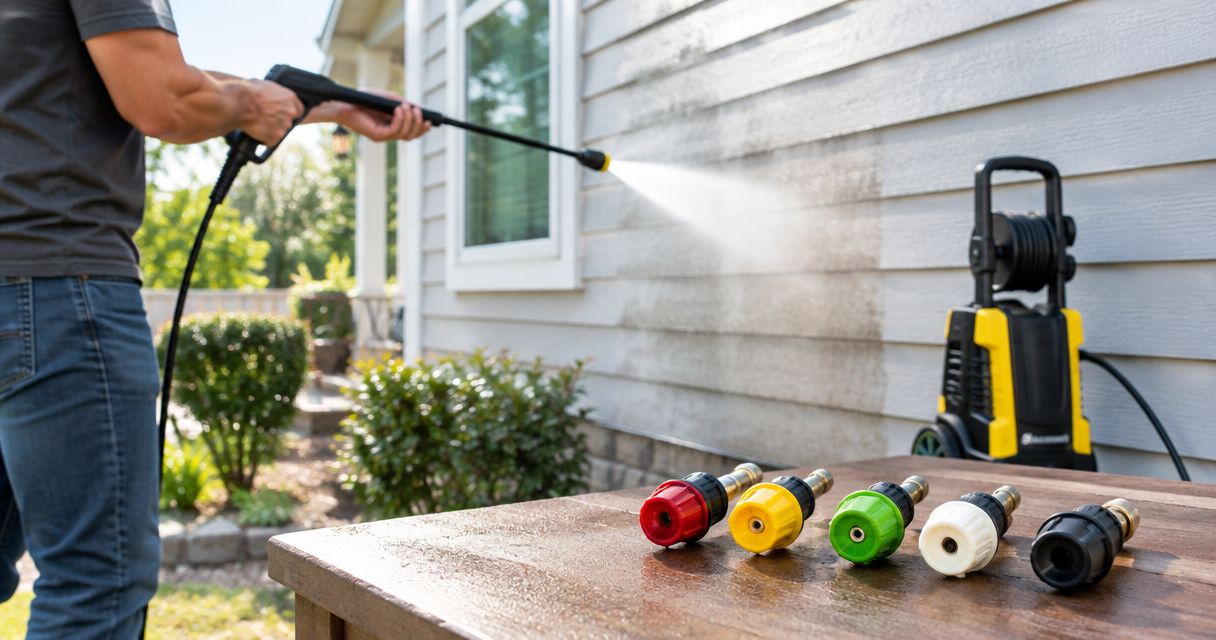
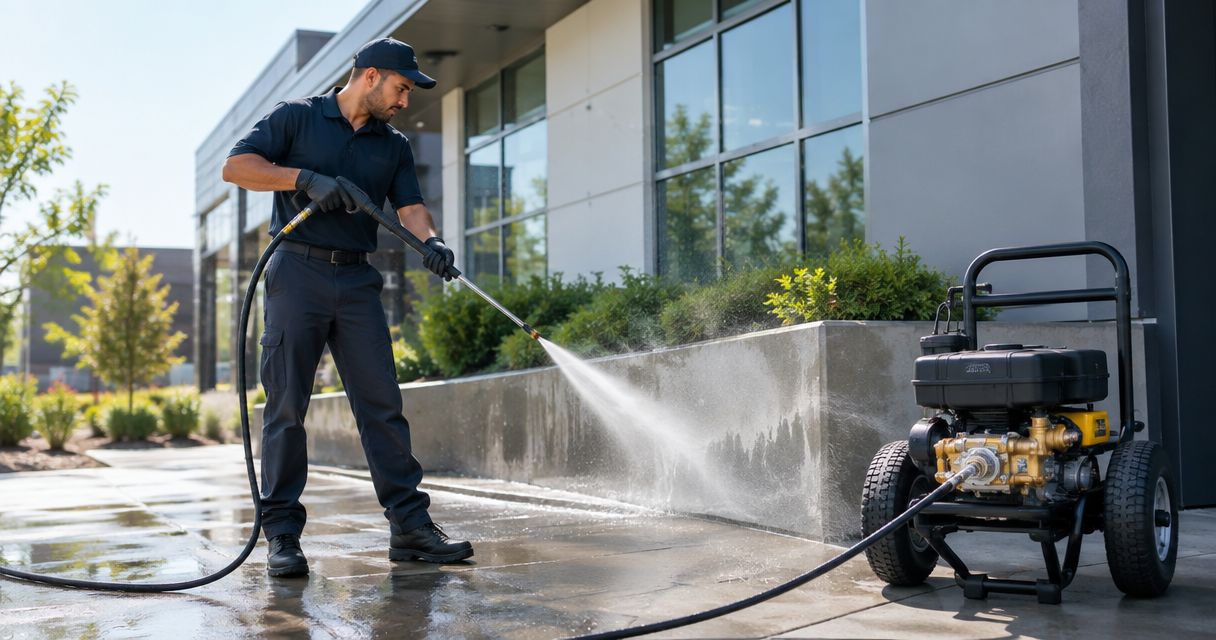
Concrete cleaning and house washing should not share one automatic setting. Suitable pressure washing can remove loosened soil from sound concrete, but excessive pressure or poor technique can damage the surface. Pressure alone is not an oil-stain treatment.
Low-pressure soft washing suits other exterior-cleaning situations, including appropriate house and roof surfaces. Sodium hypochlorite is used for organic growth in suitable cleaning applications; it is not the default answer to petroleum oil on concrete.
Specialty stain treatment addresses the specific contamination. Oil, rust, red clay, and biological growth do not become the same cleaning problem simply because they occur outdoors.
For Southernstylepressurewashing concrete cleaning and specialty stain services, ask how the proposed method fits the material and stain. A useful plan separates chemical treatment, appropriate washing, and any remaining discoloration.
Protect the property before cleaning begins
Ask who will move porch chairs, mats, planters, and other items out of the work area. Older homeowners should not have to carry heavy furniture merely to make a cleaning appointment possible; agree on assistance beforehand.
Identify nearby plants and prevent cleaner exposure through controlled application. Landscaping rinsing is relevant where cleaning chemistry requires it, and an appropriate neutralizer can have a role in specific treatment plans. Neither replaces avoiding overspray and following chemical instructions.
Commercial properties also need a plan for pedestrian routes, vehicle access, and contaminated runoff. Discuss those arrangements with Southernstylepressurewashing before work starts rather than assuming the cleaning area can remain in normal use.
Which concrete oil cleaner should you choose?
Choose a concrete-labeled alkaline degreaser as your default for general oil cleanup on compatible concrete. Choose an oil-removing poultice for a stubborn, isolated spot; select a microbial or enzyme cleaner for gradual treatment; use a mild detergent degreaser for light residue after a fresh spill.
For 2026 exterior maintenance, stop treating every mark as a reason to increase pressure. If the coating is uncertain, the surface is deteriorating, or runoff is difficult to control, professional assessment is the better next move.
FAQ
What's the best degreaser for oil stains on concrete?
A concrete-labeled alkaline degreaser is the default choice for general oil cleanup on compatible concrete. Older, isolated stains can call for an oil-removing poultice instead. Check the specific product's surface and coating instructions.
Can old oil stains be completely removed from a driveway?
Complete removal of an old oil stain is not guaranteed. Treatment can remove contamination and improve appearance while absorbed discoloration remains. Assess the result after the concrete dries.
Is a poultice better than a liquid degreaser?
An oil-removing poultice is better suited to a localized, persistent stain, while a liquid degreaser suits general oily-soil cleanup. The better choice depends on the stain pattern and surface compatibility. Neither guarantees complete removal.
Can I pressure wash an oil stain without using a degreaser?
Pressure washing alone is not a reliable treatment for absorbed oil. Remove free oil first and select a compatible stain treatment. Excessive pressure can damage concrete without solving the discoloration.
Does bleach remove motor oil from concrete?
Bleach is not the default cleaner for motor oil on concrete. Sodium hypochlorite is used for organic growth in suitable exterior-cleaning applications. Petroleum contamination needs an oil-appropriate treatment.
Can I use concrete degreaser on a sealed driveway?
Use a concrete degreaser on a sealed driveway only when its instructions cover the coating. Test an inconspicuous area and inspect it after drying. Compatibility with bare concrete does not establish compatibility with a sealer.
Should I choose an enzyme cleaner for driveway oil stains?
Choose an enzyme cleaner when its label specifically covers petroleum stains on concrete and its treatment conditions fit your property. Enzyme and microbial products differ, so do not assume they work identically. Follow the individual formula's instructions.
When should I hire a professional for concrete oil cleaning?
Hire a professional when surface condition, coating compatibility, extensive contamination, or runoff handling makes the job difficult to manage. Southernstylepressurewashing offers concrete cleaning and specialty stain services for residential and commercial property owners. Ask for the treatment approach and realistic expectations before work begins.
One last thing
Judge the stain when the concrete is dry, not while it is wet. A wet driveway can make a remaining mark less obvious and disguise an uneven result.
Keep your original photograph and compare the same area under similar lighting. That simple check helps you distinguish actual improvement from a temporarily different appearance—and prevents another unnecessary round of aggressive cleaning.