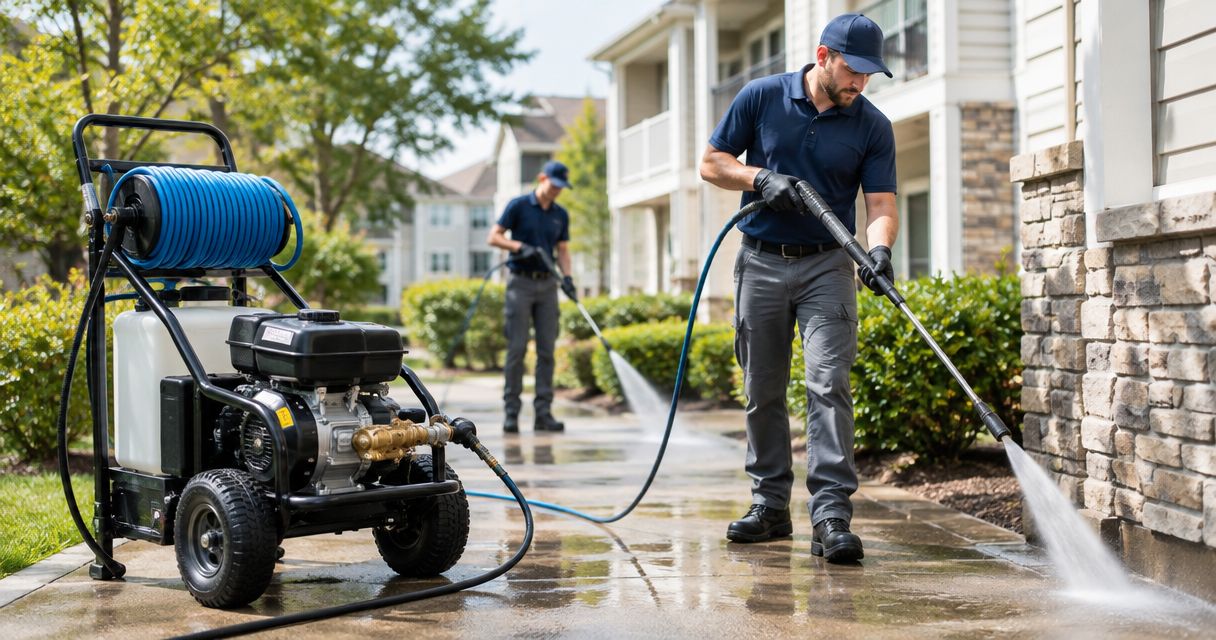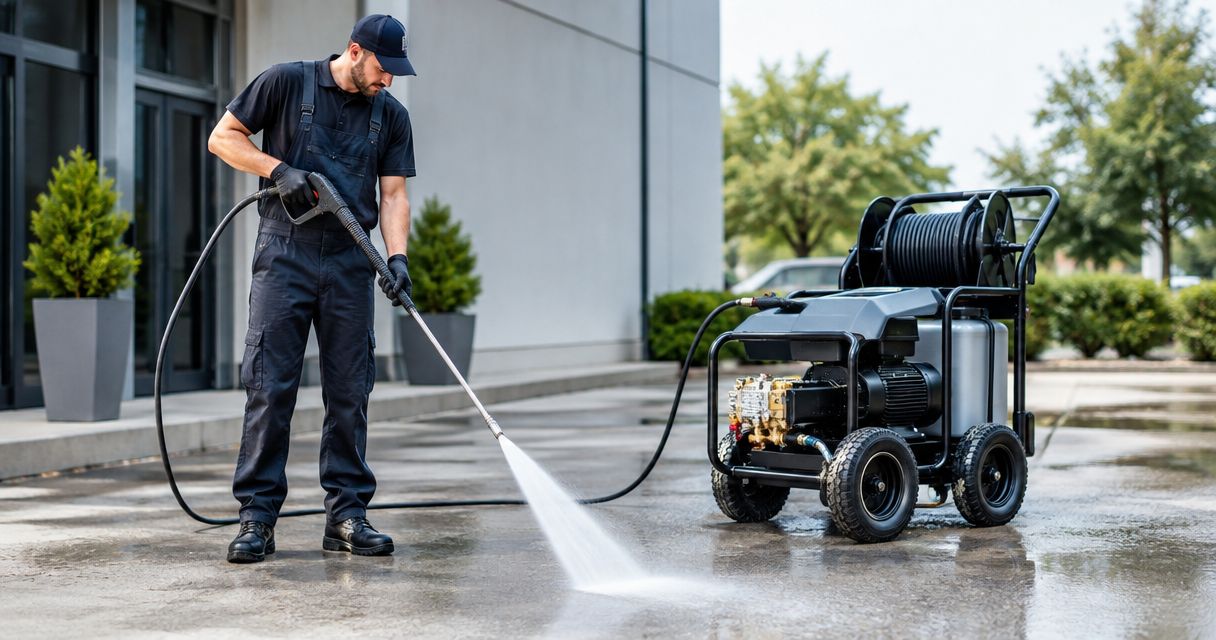
Best overall for routine commercial concrete work: a serviceable belt-drive cold-water setup. Best for greasy service areas: a hot-water skid; best for occasional compact-site work: a direct-drive cold-water unit. This 2026 guide ranks equipment configurations by repair access, maintenance demands, and suitability for the surface—not by an unverified promise of longer life.
- For commercial power washing equipment ranked by durability, prioritize repair access and surface suitability over maximum pressure.
- Serviceable belt-drive cold-water equipment is the default recommendation for routine commercial concrete cleaning.
- Hot-water equipment suits greasy service areas but adds burner maintenance.
- Soft-wash equipment belongs on suitable siding and roofs; surface cleaners belong on suitable flatwork.
Why this matters
Durability is not just whether an engine starts. A commercially useful cleaning system also needs repairable pumps, sound hoses, suitable seals, and components that tolerate the cleaning solution passing through them. Equipment that survives heavy use still fails the job if it damages the building.
Southern Style Soft Wash is best for homeowners and commercial property owners who need exterior cleaning matched to the surface. The family-owned company serves LaGrange, Newnan, Valley, and surrounding West Georgia and East Alabama areas. You can review its exterior cleaning services before deciding whether equipment ownership fits your property-maintenance needs.
For a 2026 equipment decision, separate machine durability from cleaning results. A powerful washer does not replace low-pressure roof cleaning, and a general wash does not replace treatment selected for rust, red clay, or oil.
What makes the best commercial power washing equipment?
Use these criteria before comparing equipment labels or engine size:
- Repair access: Look for an accessible pump, replaceable wear components, and a clear parts diagram. A sealed assembly gives you fewer repair choices.
- Water supply: Match the machine's required inlet supply to the actual site. A powerful machine with inadequate incoming water is the wrong setup.
- Chemical compatibility: Check the wetted components against the intended cleaner. Sodium hypochlorite compatibility matters for soft-wash equipment.
- Mechanical protection: Inspect hose routing, guards, mounting points, and frame condition. Transport damage counts as an equipment failure.
- Maintenance clarity: Require written instructions for pump care, storage, burner service where applicable, and chemical flushing.
- Surface suitability: Choose pressure, heat, chemistry, and attachments for the material and stain. Maximum output is not a cleaning method.
For a property-management purchasing decision, the commercial pressure washer guide for property managers provides a related starting point. Keep equipment selection separate from the decision about who operates it.
Commercial power washing equipment at a glance
This 2026 ranking gives routine concrete cleaning the default slot. The other configurations win distinct jobs rather than competing for every surface.
| Rank and configuration | Best for | Durability feature to require | Key limitation |
|---|---|---|---|
| 1. Serviceable belt-drive cold-water setup | Routine mixed commercial concrete work | Accessible pump, guarded belts, replaceable wear parts | Belts and alignment add maintenance |
| 2. Hot-water skid | Greasy service areas on suitable surfaces | Accessible burner, coil, pump, and service points | More components require attention |
| 3. Direct-drive cold-water unit | Occasional work at compact sites | Serviceable pump and accessible engine connections | Repair access varies by construction |
| 4. Chemical-compatible soft-wash system | Suitable siding and roof cleaning | Compatible seals, hoses, pump, and fittings | Chemistry requires careful handling |
| 5. Repairable surface-cleaner attachment | Broad, suitable concrete flatwork | Serviceable swivel, protected spray bar, replaceable nozzles | Depends on the pressure washer feeding it |
Do not treat these positions as measured lifespan results. They are a purchasing order based on job fit and inspectable maintenance features. An individual machine's construction and condition still decide whether it belongs on your shortlist.
1. Belt-drive cold-water setup: best for routine concrete work
A belt-drive cold-water setup separates the engine and pump through a belt transmission. It earns the default recommendation when you need routine commercial concrete cleaning and can inspect and maintain the drive components. Look for accessible service points rather than assuming every belt-drive machine is built equally well.
Belt-drive cold-water setup pros:
- A serviceable pump gives you a repair path for worn components.
- Separate drive components support inspection of belts, pulleys, and alignment.
- Cold-water operation avoids the burner system used by hot-water equipment.
Belt-drive cold-water setup cons:
- Belts, guards, and alignment require attention.
- Cold water alone does not address every oily residue or specialty stain.
Before selecting one, inspect the frame and mounting points. Check whether routine maintenance requires removing unrelated components, and confirm how the inlet water reaches the pump. Easy access matters during an ordinary service visit, not just after a breakdown.
Best for: Regular cleaning of suitable commercial concrete where the operator can maintain a larger setup.
Verdict: Buy for recurring concrete work when repair access and water-supply requirements fit the site.
2. Hot-water skid: best for greasy service areas
A hot-water skid combines pressure-washing equipment with a heating system. Heat helps with greasy soils on suitable surfaces, but it does not make every oil stain removable. Oil that has penetrated concrete can remain visible after surface residue is cleaned.
Hot-water skid pros:
- Heated water supports cleaning greasy surface deposits.
- A skid groups the cleaning equipment into a mounted assembly.
- Accessible burner and coil components provide defined service points.
Hot-water skid cons:
- The burner and heating coil add maintenance tasks.
- Heat is unsuitable for some materials and finishes.
Assess burner access, fuel-system condition, ventilation requirements, and coil service instructions. A clean exterior does not establish the condition of the heating system. Ask for maintenance records when evaluating used equipment.
For a 2026 commercial maintenance plan, reserve heat for work that actually needs it. A greasy service pad and a painted entrance are different cleaning assignments, even when they belong to the same building.
Best for: Greasy service areas where the material, drainage arrangements, and cleaning plan support heated-water use.
Verdict: Buy for recurring greasy-soil work; hold when routine dirt and organic growth are the main problem.
3. Direct-drive cold-water unit: best for occasional compact-site work
A direct-drive unit connects the pump directly to the engine or motor. It removes the belt transmission from the setup, but that alone does not establish better durability. Pump construction, water supply, and maintenance access remain decisive.
Direct-drive cold-water unit pros:
- No drive belts need tensioning or replacement.
- A compact arrangement suits sites with limited storage or working space.
- A serviceable pump allows maintenance beyond replacing the whole assembly.
Direct-drive cold-water unit cons:
- Close component placement can restrict repair access.
- A sealed or poorly supported pump limits repair options.
Look past the outer frame. Locate the pump service points, inspect hose connections, and confirm the manufacturer's inlet requirements. Decide how you will move the equipment without pulling it by the hose or exposing fittings to impacts.
Occasional use does not eliminate storage care. Follow the equipment instructions for draining, flushing, and protecting components between jobs. Neglected storage can undermine an otherwise suitable machine.
Best for: Occasional cleaning of suitable hard surfaces at properties where compact handling matters.
Verdict: Buy for intermittent compact-site work; skip units with unclear pump service instructions.
4. Soft-wash system: best for suitable siding and roofs
A soft-wash system delivers cleaning solution at low pressure rather than relying on high-pressure impact. It belongs in a durability guide because chemical exposure creates different equipment demands. Hoses, seals, valves, and pumps must suit the solution they carry.
Soft-wash system pros:
- Low-pressure application suits appropriate house and roof-cleaning methods.
- Compatible wetted components support a defined chemical-handling process.
- Separate chemical delivery avoids treating every surface as pressure-washing work.
Soft-wash system cons:
- Chemical handling requires protective equipment and controlled application.
- Low pressure does not remove the need to protect plants and surrounding materials.
Sodium hypochlorite is used in exterior cleaning to treat organic growth. Follow product directions and surface guidance rather than guessing a mixture. Plan landscaping rinsing, controlled runoff, and neutralizer use where appropriate; neutralizer does not replace careful application.
Southern Style Soft Wash matches commercial power washing equipment and soft-wash methods to the surface rather than using one method everywhere. That distinction matters for residential siding, roofs, commercial façades, and nearby concrete.
Best for: Suitable siding and roof surfaces affected by organic growth, with a trained operator and a property-protection plan.
Verdict: Buy for a defined soft-washing program; skip high-pressure roof cleaning as a substitute.
5. Surface-cleaner attachment: best for broad concrete flatwork
A surface cleaner uses a rotating spray bar inside a housing to clean suitable flat surfaces. It is an attachment, not a standalone washer. Durability depends on its swivel, bearings where fitted, spray bar, nozzles, and compatibility with the feeding machine.
Surface-cleaner attachment pros:
- A housing helps contain spray around the working area.
- A rotating spray bar supports a repeatable cleaning pattern.
- Replaceable nozzles and a serviceable swivel provide repair options.
Surface-cleaner attachment cons:
- Incorrect flow or nozzle matching compromises operation.
- Broad coverage does not resolve penetrated oil, rust, or damaged concrete.
Inspect the underside, not just the handles. Look for a bent spray bar, damaged nozzles, loose connections, and clear swivel-service instructions. Confirm compatibility from the equipment documentation before connecting an attachment.
Keep cleaning and stain treatment separate. Rust and red clay require assessment and suitable chemistry; additional passes with a surface cleaner are not a substitute. Worn concrete and failing sealers also need a different response from sound, uncoated concrete.
Best for: Broad, suitable concrete walkways, driveways, and commercial flatwork.
Verdict: Buy as a matched attachment for recurring flatwork; skip the assumption that it removes every stain.
Protect the property before starting the equipment
A sound 2026 cleaning plan protects both the machine and the property. Before work begins, identify fragile finishes, damaged mortar, loose coatings, drainage routes, and items that need moving. Ask older homeowners whether porch furniture or other obstacles require assistance instead of assuming they can clear everything themselves.
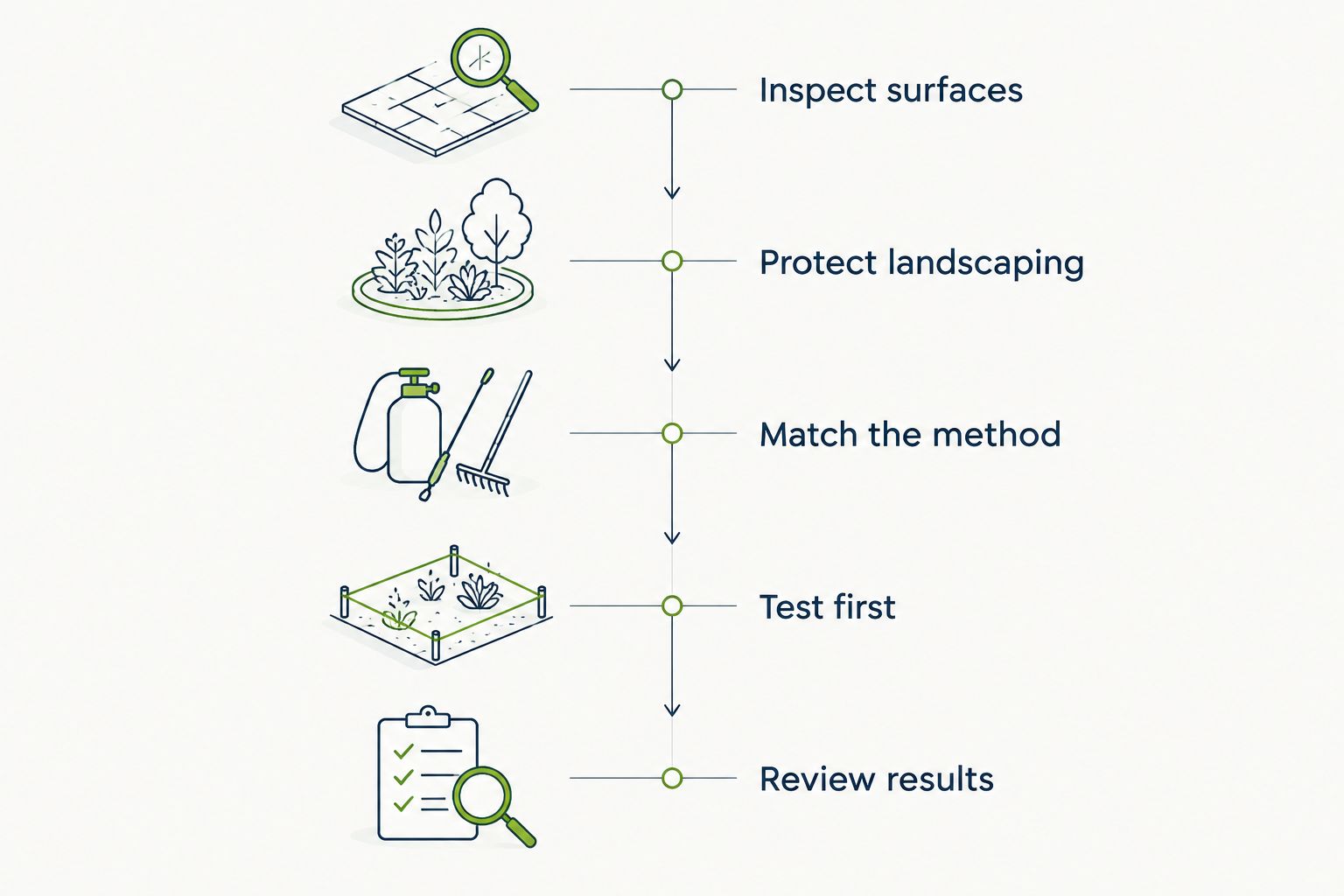
Use this sequence for planning:
- Inspect surfaces: Identify the material, condition, coating, and stain before choosing a method.
- Protect landscaping: Plan rinsing before and during work, and neutralizer where appropriate.
- Match the method: Choose low-pressure soft washing, suitable pressure washing, or specialty stain treatment.
- Test first: Check a discreet area and assess the response before treating the full surface.
- Review results: Distinguish removed surface contamination from remaining discoloration or material damage.
No responsible contractor can promise zero risk or complete removal of every stain. Southern Style Soft Wash emphasizes surface-matched cleaning and honest limits; you should expect that same distinction when comparing equipment or service proposals.
How this equipment ranking works
The 2026 order follows the criteria above: repair access, water supply, chemical compatibility, mechanical protection, maintenance clarity, and surface suitability. Belt-drive cold-water equipment takes the default position for routine concrete work; specialized equipment takes priority when the task changes.
This is not a manufacturer leaderboard. Inspect the actual unit, read its documentation, and confirm parts support before buying. A neglected example of the top configuration is not a better purchase than a well-maintained machine suited to your work.
Which commercial power washing equipment should you choose?
Choose a serviceable belt-drive cold-water setup for recurring commercial concrete cleaning. Choose hot-water equipment for appropriate greasy-soil work, direct drive for occasional compact-site work, soft washing for suitable siding and roofs, and a matched surface cleaner for broad flatwork.
If you manage mixed residential or commercial surfaces, start with the cleaning scope rather than a machine purchase. Southern Style Soft Wash serves property owners who need house, roof, concrete, and specialty stain cleaning—not a single pressure setting applied everywhere.
FAQ
What's the best commercial power washing equipment ranked by durability?
A serviceable belt-drive cold-water setup is the default recommendation for routine commercial concrete work. This ranking prioritizes repair access and job suitability, not a measured lifespan advantage over every other configuration.
Is a belt-drive pressure washer always more durable than direct drive?
No, belt drive alone does not establish greater durability. Pump construction, maintenance, incoming water, component protection, and the condition of the individual machine all matter.
Should commercial property owners choose hot-water equipment?
Choose hot-water equipment when recurring greasy-soil work on suitable surfaces justifies the heating system. Routine dirt and organic growth do not automatically require heat, and the burner adds maintenance.
Can commercial power washing equipment clean an asphalt-shingle roof?
Do not use high-pressure washing as a substitute for an appropriate asphalt-shingle roof-cleaning method. Use surface guidance and a suitable low-pressure process, with careful chemical application and property protection.
What should I inspect on a used commercial pressure washer?
Inspect the pump, hoses, fittings, frame, service points, and maintenance records. For hot-water equipment, also review the burner and coil; for belt-drive equipment, inspect belts, guards, and alignment.
Does a surface cleaner remove oil and rust stains completely?
No, a surface cleaner does not guarantee complete oil or rust removal. Specialty treatment can improve discoloration, but penetrated staining and damaged material can remain visible.
How do I protect landscaping during soft washing?
Plan controlled application, landscaping rinsing, and neutralizer where appropriate for the cleaning process. Follow chemical directions and protect surrounding materials; low pressure does not mean zero risk.
One last thing
The strongest machine on paper can still be the wrong tool for your building. Before approving a 2026 purchase or cleaning proposal, ask one question: What changes when the work moves from concrete to siding, then to the roof? A credible answer changes the method, chemistry, and protection plan—not just the nozzle.