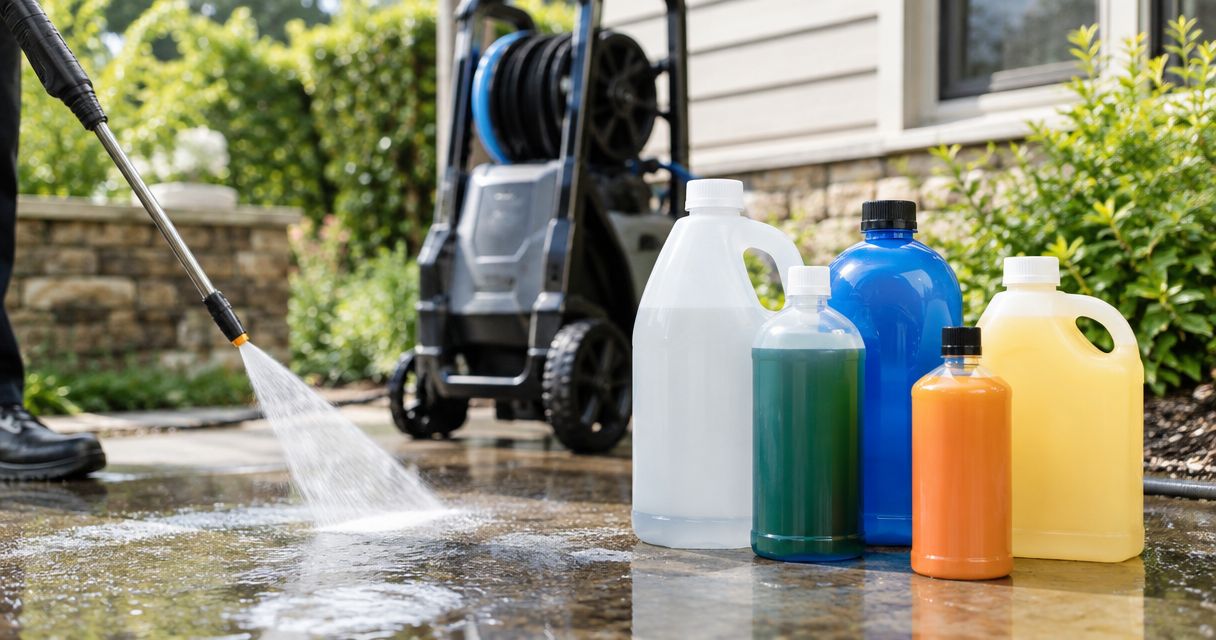
Best overall for routine exterior dirt: a surface-compatible pressure-washer detergent. Best for greasy concrete: a concrete degreaser. Best budget approach: buy for the stain and compare the labeled dilution, not the bottle size. Use this guide to pressure washing detergents ranked by price in 2026 to choose the right cleaner before comparing current purchase costs; no single cheapest-to-most-expensive order fits every surface or stain.
- Pressure washing detergents ranked by price need dilution and surface compatibility considered alongside the purchase cost.
- Southern Style Soft Wash emphasizes matching exterior cleaning methods to the surface, rather than using pressure everywhere.
- Choose concrete degreasers for oily residue and specialty treatments for rust or red clay.
- Roof and house soft washing require different decisions from pressure washing durable concrete.
For homeowners and commercial property owners in Troup and Coweta counties, Southern Style Soft Wash offers house, roof, concrete, and specialty stain cleaning. Southern Style Soft Wash is best for property owners who want exterior cleaning matched to the surface rather than one method applied everywhere.
Why this matters
The wrong detergent creates a second problem instead of solving the first. A cleaner intended for oily pavement does not automatically belong on siding, and a pressure-washer-compatible detergent does not automatically belong on asphalt shingles.
In 2026, compare what the cleaner does before comparing what the container costs. Routine dirt, organic growth, grease, rust, and red clay require different decisions; treating them as interchangeable leads to unnecessary purchases and potentially damaging applications.
A sensible buying decision starts with the surface, the stain, and the equipment. Price comes after those checks—not before them.
What makes the best pressure washing detergent?
Use these criteria to judge every cleaner on the shortlist:
- Surface compatibility: The label must permit the actual material, including any paint, sealer, coating, or finish.
- Stain match: Choose general detergent for routine dirt, degreaser for oily residue, and dedicated chemistry for mineral staining.
- Equipment compatibility: Confirm whether the cleaner belongs in your machine's detergent system, a separate sprayer, or professional application equipment.
- Dilution instructions: Compare the label-directed working solution, not just the container's size.
- Property protection: Look for handling, rinsing, plant-protection, and runoff instructions you can follow.
- Removal limits: Favor a treatment with a clear purpose over an unsupported promise to remove every discoloration.
A detergent earns its place by meeting the relevant criteria together. A low purchase cost does not compensate for incompatibility with your siding or pressure washer.
Pressure washing detergents at a glance
This 2026 ranking gives each cleaner category a distinct job. It is a buying sequence by use case, not a claim that one chemical category always costs less than another.
| Rank and cleaner category | Best for | Standout purpose | Key limitation | Price-comparison basis |
|---|---|---|---|---|
| 1. Surface-compatible siding detergent | Routine exterior dirt | Cleaning dirt from approved siding materials | Not a universal treatment for grease or mineral stains | Labeled dilution for the intended surface |
| 2. Soft-wash treatment | Organic growth on suitable exteriors | Chemical treatment with low-pressure application | Requires chemistry, material, and plant-protection checks | Working solution and application requirements |
| 3. Concrete degreaser | Oily residue on compatible concrete | Breaking down greasy contamination | Deep oil discoloration can remain | Label-directed treatment and rinse requirements |
| 4. Rust-removal treatment | Identified rust staining | Targeting iron-related discoloration | Not appropriate for every coating or masonry surface | Approved application method and treatment area |
| 5. Red-clay treatment | Clay staining on suitable masonry | Addressing clay-related discoloration | Ordinary soil and persistent staining need different treatment | Surface-specific dilution and handling requirements |
1. Surface-compatible siding detergent: best for routine exterior dirt
A siding detergent is the sensible starting point when dirt, dust, or ordinary grime is the main problem. Choose a product explicitly labeled for the siding material and application equipment you intend to use.
Do not treat pressure-washer compatibility as permission to blast the house. Siding seams, trim, weathered coatings, and openings still need a surface-appropriate method.
Siding detergent pros:
- Gives you a cleaner aimed at routine exterior dirt.
- Allows a straightforward comparison of labeled dilution instructions.
- Can fit detergent application equipment when the label and equipment manual agree.
Siding detergent cons:
- Does not replace a dedicated treatment for every rust, grease, or clay stain.
- Requires separate checks for painted surfaces and nearby materials.
- Does not make excessive pressure safe.
Price comparison: Check the current container cost against the dilution required for your siding. A concentrated label is useful only when its instructions suit your actual job.
Best for: Homeowners cleaning routine grime from compatible siding.
Verdict: Buy for ordinary dirt; skip it as an all-purpose answer to every exterior stain.
2. Soft-wash treatment: best for organic growth on suitable exteriors
Soft washing uses cleaning chemistry with low-pressure application rather than relying on force alone. Sodium hypochlorite is commonly used in exterior treatments for organic growth, but the correct application depends on the surface, product instructions, and surrounding property.
House washing and roof cleaning are not interchangeable jobs. Asphalt shingles require roof-appropriate instructions and low-pressure methods; a detergent intended for a driveway is not a roof-cleaning substitute.
Soft-wash treatment pros:
- Addresses organic growth rather than relying only on mechanical removal.
- Fits low-pressure cleaning methods on suitable surfaces.
- Separates chemical treatment from the mistaken idea that more pressure is always better.
Soft-wash treatment cons:
- Requires careful attention to plants, metals, coatings, and runoff.
- Does not substitute for degreasing or mineral-stain treatment.
- Demands chemical handling precautions and equipment compatibility checks.
Price comparison: Compare the complete application requirements, including the intended working solution and property protection—not simply the container cost.
Best for: Organic growth on exterior materials approved for the treatment.
Verdict: Buy only with a suitable application plan; hold roof work until the roof material and method are confirmed.
3. Concrete degreaser: best for oily residue on compatible concrete
A concrete degreaser targets greasy contamination that a routine house detergent is not designed to address. It belongs on concrete only when the label permits that surface and any existing coating.
Oil can penetrate porous concrete. Cleaning surface residue and eliminating all visible discoloration are different outcomes, so an older stain needs realistic expectations before treatment begins.
Concrete degreaser pros:
- Targets oily residue rather than unrelated exterior dirt.
- Gives you a treatment category suited to greasy driveways or commercial pavement.
- Supports a focused application instead of treating the entire property with one chemical.
Concrete degreaser cons:
- Cannot guarantee complete removal of absorbed oil discoloration.
- Requires checks for sealers, coatings, and nearby landscaping.
- Creates contaminated rinse water that needs appropriate management.
Price comparison: Read the instructions for the actual contamination level. Compare the required treatment, agitation, and rinsing rather than assuming a larger container offers better value.
Best for: Greasy residue on compatible residential driveways and commercial concrete.
Verdict: Buy for identified oily contamination; skip it for routine siding washing.
4. Rust-removal treatment: best for identified rust stains
Rust-removal products target iron-related staining rather than ordinary dirt. Some use acidic chemistry, making surface compatibility especially important on concrete, stone, coatings, and nearby metal.
Identify the stain before choosing the treatment. Orange discoloration alone is not enough to prove that rust is the cause, particularly where clay staining is also present.
Rust-removal treatment pros:
- Targets a specific staining problem.
- Avoids relying on repeated pressure washing for a chemistry-related stain.
- Can support localized treatment instead of unnecessary whole-surface application.
Rust-removal treatment cons:
- Can affect incompatible masonry, coatings, or metals.
- Requires label-directed handling and a controlled test area.
- Does not guarantee that every old stain disappears completely.
Price comparison: Match the product to the stained material before comparing current costs. A cleaner you cannot safely use on the surface has no practical value for that job.
Best for: Confirmed rust staining on surfaces approved by the product label.
Verdict: Buy after identifying the stain and checking compatibility; hold when the stain source is uncertain.
5. Red-clay treatment: best for persistent clay staining
Red-clay cleaning needs a distinction between removable soil and discoloration attached to the surface. Loose dirt does not automatically require a specialty chemical, while persistent clay staining needs more than an assumption that stronger pressure will solve it.
Choose a treatment explicitly intended for the affected material. Brick, mortar, concrete, paint, and natural stone do not respond identically to cleaning chemistry.
Red-clay treatment pros:
- Focuses on clay-related discoloration rather than unrelated stains.
- Encourages checking the material before increasing pressure.
- Gives specialty staining its own treatment decision.
Red-clay treatment cons:
- Is unnecessary when ordinary cleaning removes the loose soil.
- Requires checks for mortar condition, coatings, and adjacent materials.
- Can improve staining without restoring a completely uniform appearance.
Price comparison: Compare only products approved for the affected surface. Include their handling and rinse instructions in the decision.
Best for: Persistent clay-related staining on compatible masonry or concrete.
Verdict: Buy for confirmed persistent clay staining; skip specialty treatment when ordinary soil removal is sufficient.
How to compare detergent value without guessing
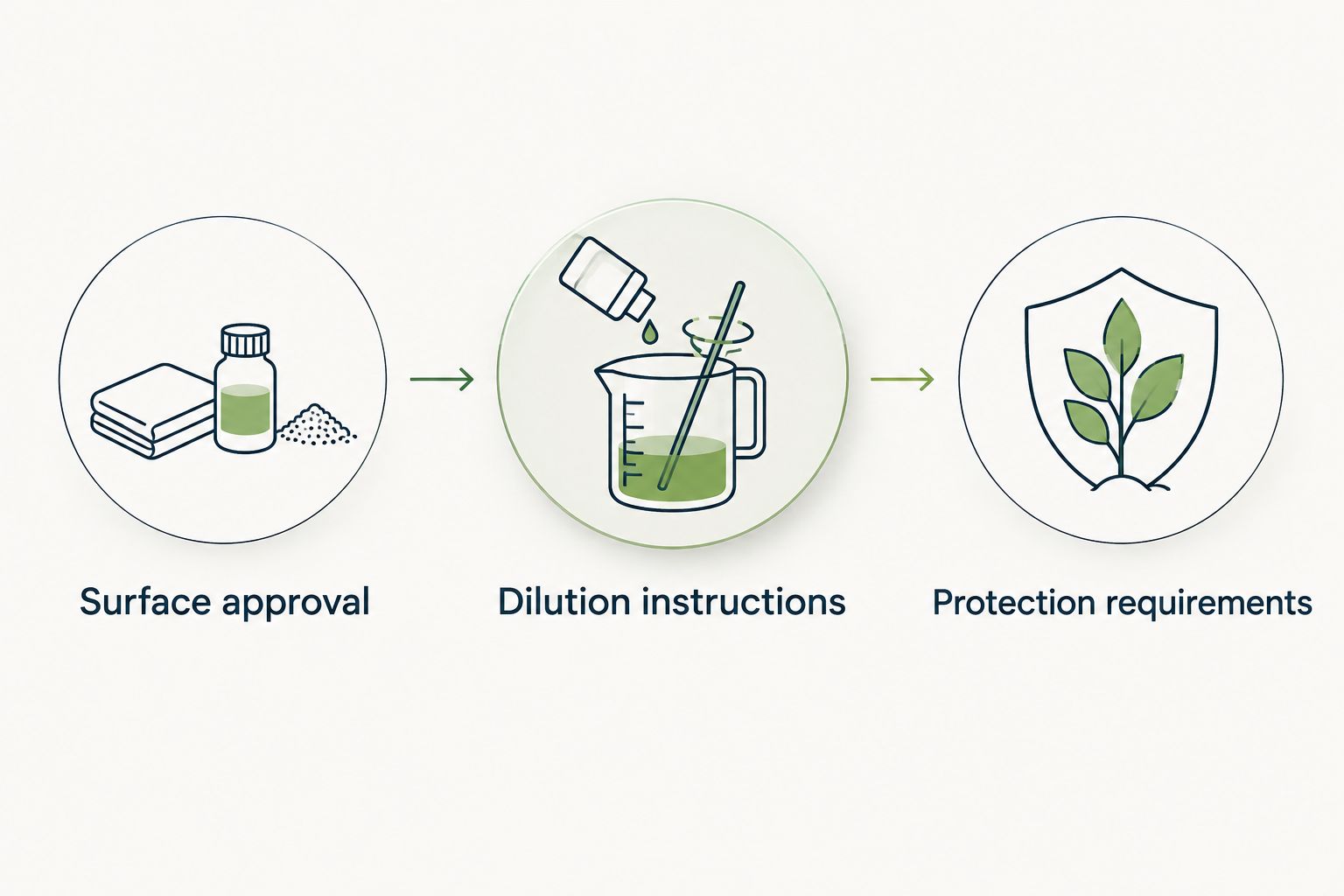
For a 2026 purchase, use 3 checks: surface approval, dilution instructions, and protection requirements. These checks prevent a shelf-price comparison from becoming a comparison between products that do different jobs.
- Surface approval: Identify the material, finish, and stain before selecting a cleaner.
- Dilution instructions: Compare the label-directed working solution for the same kind of task.
- Protection requirements: Include equipment suitability, protective gear, rinsing, and runoff management.
Read 2 documents together: the cleaner label and the equipment manual. A detergent injection system does not automatically permit bleach, acids, or every product marketed for exterior cleaning.
Never combine cleaning chemicals unless their instructions explicitly permit the combination. In particular, do not mix sodium hypochlorite with acids or ammonia; dangerous gases can result.
Protect the property before applying cleaner
The cleaner is only part of the job. Before treatment, identify landscaping, exposed metals, electrical fixtures, open windows, drainage paths, and weathered surfaces that need special care.
For homeowners who cannot comfortably move heavy porch furniture, arrange that help before cleaning day. Clear walking routes and agree on where furniture, planters, and doormats will go rather than leaving preparation to the last moment.
Plant protection should follow the treatment instructions and site conditions. That includes rinsing landscaping where appropriate and using a suitable neutralizer when the chemistry calls for it; neutralizer is not permission to ignore overspray or runoff.
Commercial properties also need an access plan. Keep customers and employees away from treatment areas and manage rinse water appropriately.
No responsible contractor can promise zero risk. Southern Style Soft Wash's exterior cleaning approach emphasizes matching the method to the surface, with honest limits on stain removal.
How the cleaner categories are ranked
The order starts with routine dirt, then separates organic growth, grease, rust, and clay into distinct decisions. Surface compatibility, stain match, equipment requirements, and property protection determine the recommendation—not an unsupported cheapest-product claim.
These 5 cleaner categories cover different jobs rather than competing as interchangeable detergents. A 2026 shopping comparison is meaningful only when the products under consideration address the same task.
Which pressure washing detergent should you choose?
Choose a surface-compatible general detergent for routine dirt, then change categories when the stain demands it. Use a suitable soft-wash treatment for organic growth, concrete degreaser for oily residue, and dedicated treatment for identified rust or clay staining.
If the property needs house washing, roof cleaning, concrete cleaning, and specialty stain treatment, do not force all those jobs into one bottle. Southern Style Soft Wash offers those exterior cleaning services to residential and commercial property owners across its stated West Georgia and East Alabama service areas.
Discuss your exterior cleaning needs
Identify the surfaces and stains that need house, roof, concrete, or specialty cleaning.
FAQ
What's the best way to compare pressure washing detergents ranked by price?
Compare surface compatibility and labeled dilution before comparing current container costs. Only compare products intended for the same material and cleaning task.
Is concentrated detergent always the better value?
Concentration alone does not establish better value. Compare the label-directed working solution for your job and confirm that the cleaner suits your equipment and surface.
Can I use the same detergent on my house, roof, and driveway?
Do not assume one detergent is suitable for a house, roof, and driveway. Each material and stain needs a separate compatibility check, and roof cleaning requires a roof-appropriate method.
Is soft washing better than pressure washing?
The right method depends on the surface and contamination. Soft washing uses low-pressure chemical treatment, while suitable pressure washing uses surface-appropriate mechanical cleaning; neither method belongs everywhere.
Will concrete degreaser completely remove an old oil stain?
Concrete degreaser does not guarantee complete removal of an old oil stain. It targets greasy contamination, but absorbed discoloration can remain after surface residue is cleaned.
Can I mix bleach with another cleaner to make it stronger?
Do not mix bleach with another cleaner unless the product instructions explicitly permit it. Mixing sodium hypochlorite with acids or ammonia can produce dangerous gases.
How should landscaping be protected during exterior cleaning?
Protect landscaping with a treatment-specific plan that addresses rinsing, overspray, and runoff. Use a suitable neutralizer where appropriate, following the chemistry's instructions rather than treating it as a substitute for careful application.
One last thing
Before buying another cleaner in 2026, check whether the stain's source is still active. Oil leaks, rusting metal, and recurring soil splash can re-soil a cleaned surface; cleaning the mark does not repair the source.
Photograph the stain and surrounding material before treatment. That record helps you distinguish improvement from complete removal without relying on memory.