Best overall: sodium hypochlorite for algae-stained asphalt shingles. Best chlorine-free option to evaluate: a roof-labeled hydrogen peroxide cleaner. Best oxygen-bleach option to evaluate: a roof-labeled sodium percarbonate cleaner. For homeowners considering Southern Style Soft Wash, the deciding factor is the right chemistry and low-pressure method for the roof—not the strongest chemical available.
- The best roof cleaning chemicals for shingles start with sodium hypochlorite, subject to the shingle manufacturer's instructions.
- Hydrogen peroxide and sodium percarbonate alternatives need explicit asphalt-shingle compatibility; chlorine-free does not mean harmless.
- Southern Style Soft Wash offers roof cleaning; ask how the proposed treatment matches your shingles and landscaping.
- Use low-pressure treatment for asphalt shingles, not the pressure-washing approach used on suitable concrete.
Why the cleaning method matters
Black streaks, moss, and embedded discoloration are different cleaning problems. A chemical that addresses algae does not repair worn shingles, failed flashing, or a leak. Increasing concentration or pressure does not turn a maintenance problem into a cleaning problem.
For Troup and Coweta county property owners choosing roof cleaning in 2026, the useful question is specific: what is growing on the roof, what condition are the shingles in, and what treatment does the manufacturer permit? Southern Style Soft Wash is an option for local homeowners seeking roof cleaning as a service rather than handling chemicals on a roof themselves.
This guide ranks chemical categories, not retail brands. A chemical name alone does not establish that a particular bottled formulation belongs on your roof.
What makes the best roof cleaning chemicals for shingles?
Use these criteria before choosing a cleaner or approving a contractor's plan:
- Shingle compatibility: The roof manufacturer's maintenance instructions take priority over a general exterior-cleaner label.
- Stain match: Organic growth, rust, mineral deposits, and aging require different decisions. Identify the problem before selecting chemistry.
- Low-pressure application: The cleaner must work without aggressive scrubbing or high-pressure rinsing that risks disturbing granules.
- Clear directions: The label must explain permitted surfaces, dilution, contact time, rinsing, and protective equipment.
- Property protection: The plan must address plants, gutters, downspouts, adjacent materials, and people below the work area.
- Honest limits: A responsible recommendation distinguishes treating growth from restoring damaged shingles or removing every mark.
A roof cleaner fails this checklist if its directions do not cover asphalt shingles. Advertising it for siding, patios, or general outdoor use does not fill that gap.
Roof cleaning chemicals at a glance
| Rank and chemical | Best for | Standout feature | Key limitation |
|---|---|---|---|
| Sodium hypochlorite | Manufacturer-aligned treatment of algae staining | Included in established asphalt-roof cleaning guidance | Requires careful concentration control and protection of nearby plants and materials |
| Roof-labeled hydrogen peroxide cleaner | Evaluating a chlorine-free formulation | Uses peroxide-based oxidation rather than chlorine bleach | Compatibility and results depend on the complete formulation and label |
| Roof-labeled sodium percarbonate cleaner | Evaluating an oxygen-bleach formulation | Releases hydrogen peroxide when dissolved in water | Also creates an alkaline solution; oxygen bleach is not automatically suitable for shingles |
The default choice for 2026 is manufacturer-approved sodium hypochlorite treatment—not an unrestricted recommendation for any bleach product. The alternatives belong on the shortlist only when their labels and your roofing instructions support them.
1. Sodium hypochlorite: best for algae-stained asphalt shingles
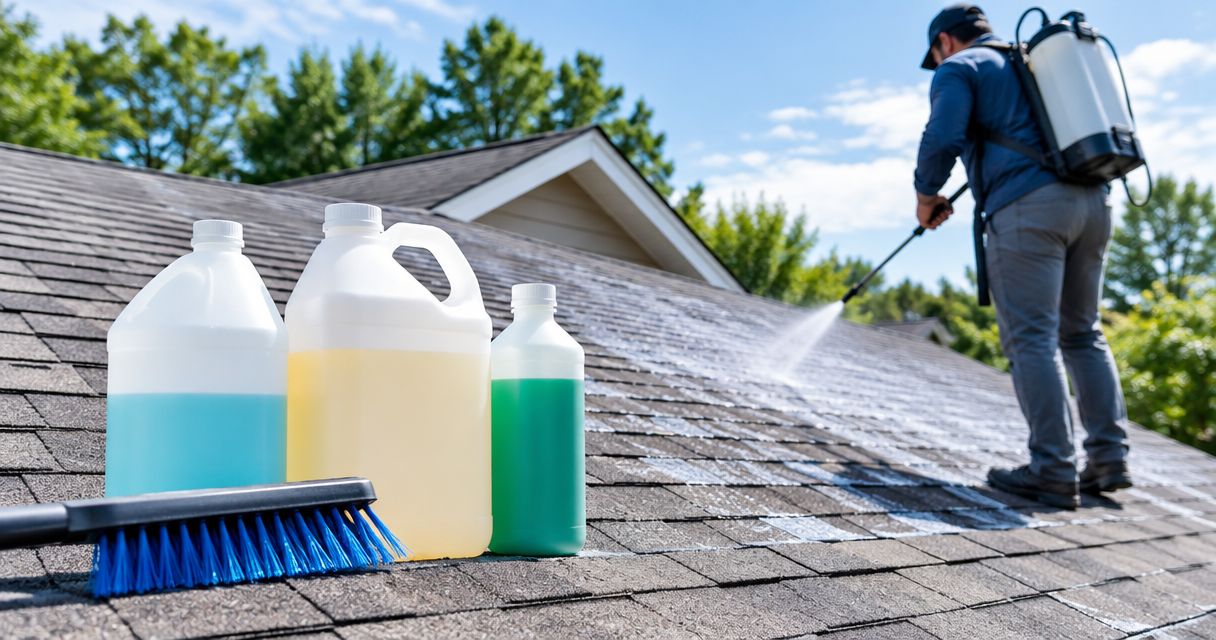
Sodium hypochlorite is the active ingredient in chlorine bleach. It treats organic growth through oxidation and appears in the Asphalt Roofing Manufacturers Association's Cleaning Asphalt Shingles guidance. That makes it the clearest starting point for evaluating an algae-cleaning plan.
ARMA describes an equal-parts mixture of laundry-strength chlorine bleach and water. Expressed as quantities, that ratio is 1 gallon of the specified bleach to 1 gallon of water; the guidance also describes 15–20 minutes of contact time before a gentle rinse. These figures belong to that specific guidance, not to every bleach formulation or roof.
Do not transfer those instructions to concentrated professional sodium hypochlorite without accounting for its strength. Check the shingle manufacturer's instructions and the chemical label before any application. For your 2026 roof-cleaning decision, the permitted finished solution matters more than the concentration printed on a stock container.
Sodium hypochlorite pros
- Has a defined place in established asphalt-shingle cleaning guidance.
- Addresses organic staining without making abrasive scrubbing the cleaning mechanism.
- Supports low-pressure treatment when the application follows the relevant instructions.
- Gives you a concrete basis for questioning a contractor's proposed chemistry.
Sodium hypochlorite cons
- Exposure can injure plants and affect susceptible adjacent materials.
- Concentrated products require correct dilution, handling, and protective equipment.
- Does not repair weathering, granule loss, or other physical roof damage.
Best for: Asphalt-shingle roofs with algae staining where the roofing instructions permit this treatment.
Verdict: Choose manufacturer-approved sodium hypochlorite treatment; skip improvised dilution and high-pressure application.
2. Hydrogen peroxide: best for evaluating a chlorine-free cleaner
Hydrogen peroxide is an oxidizing agent used in some cleaning formulations. A peroxide-based product deserves consideration only when its directions explicitly cover asphalt shingles and the roofing manufacturer accepts the treatment. The ingredient name is not a compatibility certificate.
The complete formulation matters. Other ingredients, application strength, required contact time, and rinsing instructions affect how the product is used. If the directions require vigorous brushing or pressure washing to achieve the advertised result, that process needs to be checked against the roof's maintenance instructions.
Hydrogen peroxide cleaner pros
- Provides a chlorine-free chemistry option when the roof instructions permit it.
- Offers product-specific application directions when you select a properly labeled formulation.
- Lets you evaluate an alternative without assuming every outdoor cleaner is roof-safe.
Hydrogen peroxide cleaner cons
- Chlorine-free does not mean safe for skin, eyes, landscaping, or every building material.
- A peroxide concentration alone does not establish cleaning performance or shingle compatibility.
- Generic peroxide products do not replace roof-specific directions.
Best for: Owners evaluating a chlorine-free roof cleaner with explicit asphalt-shingle instructions.
For a 2026 purchase, compare the actual label with your roof documentation. Reject a product whose suitability depends only on a broad claim such as environmentally friendly.
Verdict: Hold until both the product directions and roofing instructions support its use.
3. Sodium percarbonate: best for evaluating an oxygen-bleach cleaner
Sodium percarbonate releases hydrogen peroxide and sodium carbonate when dissolved in water. The peroxide supplies oxidizing action; the sodium carbonate makes the solution alkaline. That chemistry explains why an oxygen-bleach label does not mean plain water with a harmless additive.
Some oxygen-bleach cleaners are intended for surfaces other than roofs. A deck, masonry, or laundry application does not establish suitability for asphalt shingles. Choose only a formulation whose directions cover your roofing material, then check those directions against the shingle manufacturer's requirements.
Sodium percarbonate cleaner pros
- Provides an oxygen-bleach alternative to chlorine-based chemistry.
- Makes the active chemistry identifiable rather than relying on an unexplained natural-cleaner claim.
- Allows a product-specific assessment when the label explicitly includes asphalt shingles.
Sodium percarbonate cleaner cons
- Its alkaline solution still requires attention to compatible surfaces and protective equipment.
- Roof suitability cannot be inferred from suitability for wood, concrete, or fabric.
- Required agitation or rinsing can make a particular formulation unsuitable for the roof.
Best for: Owners considering a roof-labeled oxygen-bleach product whose complete cleaning process is permitted.
Verdict: Hold for compatibility checks; skip unlabeled household or general-purpose substitutions.
Match the treatment to the surface
Roof cleaning belongs in a wider exterior-cleaning plan, but it does not share one universal method with every other surface. Southern Style Soft Wash offers house, roof, concrete, and specialty stain cleaning services. Ask which method fits each area rather than requesting the same pressure and chemical across the property.
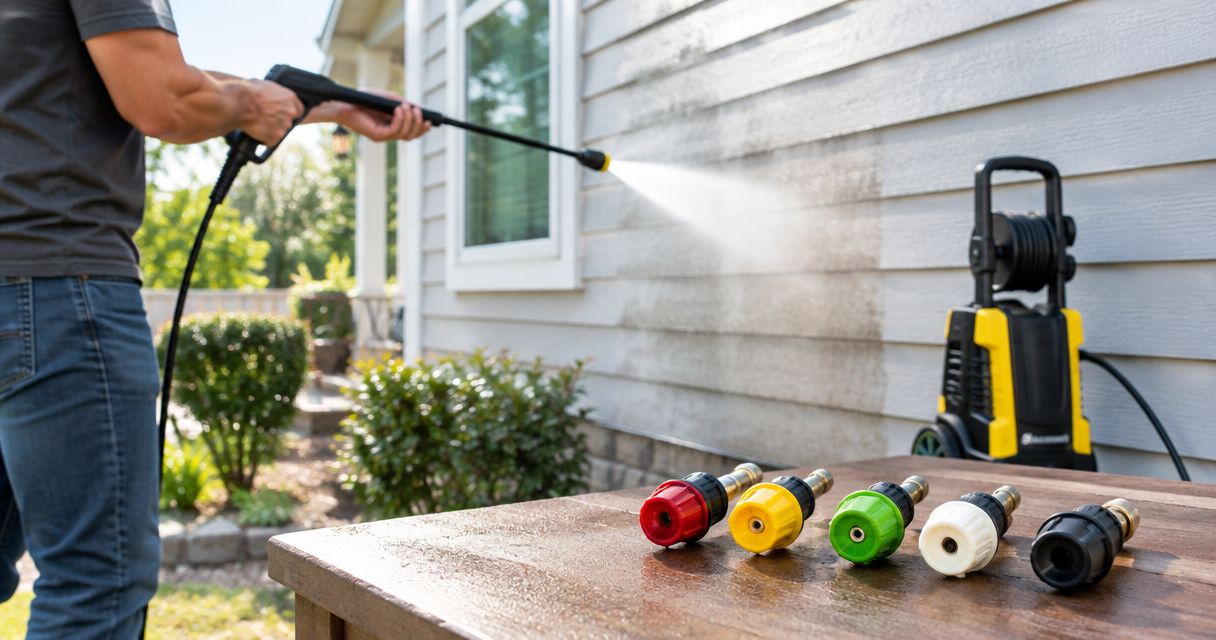
- Soft washing: Uses low-pressure application and suitable chemistry for surfaces that should not receive aggressive pressure.
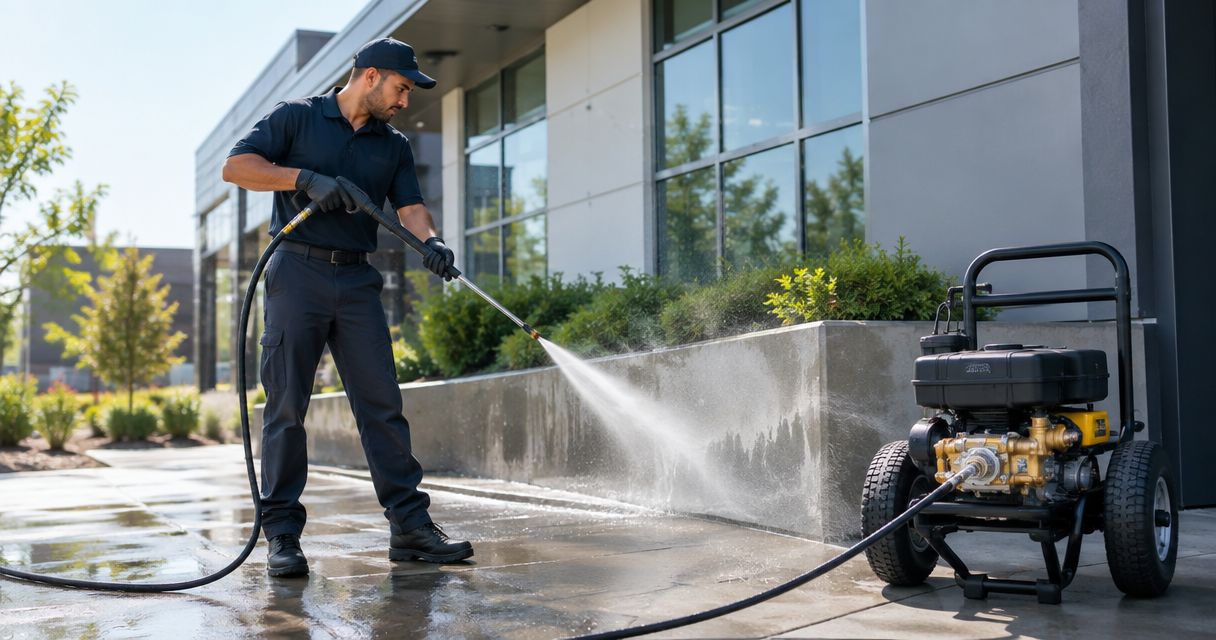
- Pressure washing: Uses surface-appropriate mechanical cleaning where the material and its condition permit it, including suitable concrete.
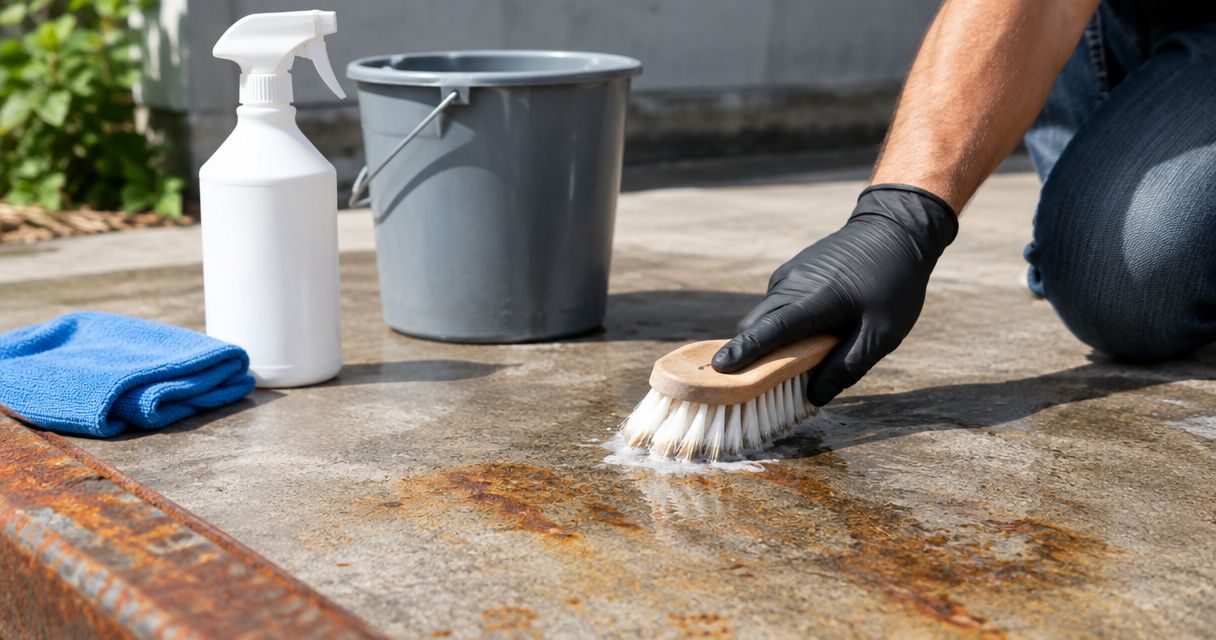
- Specialty treatment: Addresses a particular stain, such as rust or mineral discoloration, with chemistry selected for that stain and surface.
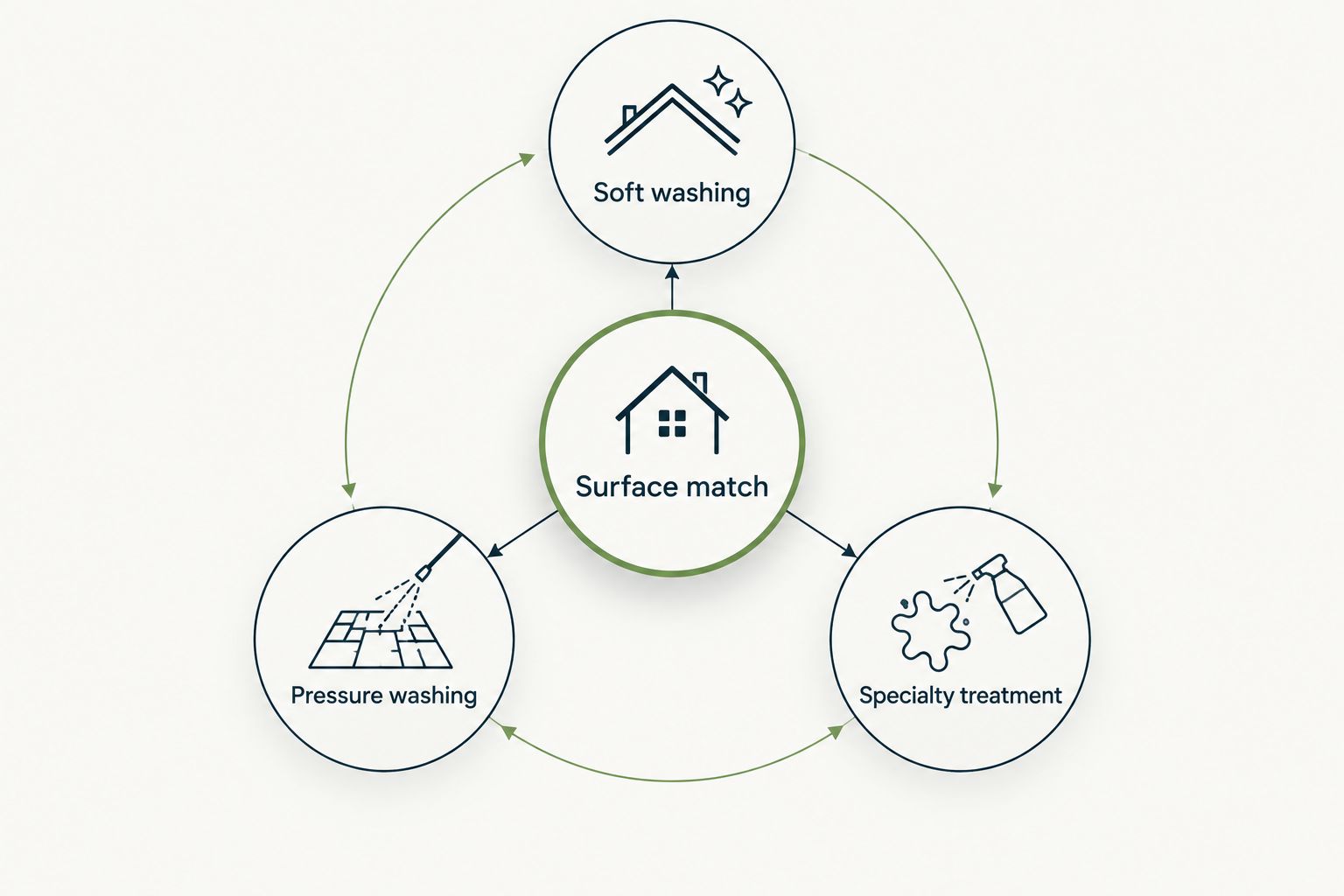
A cleaner selected for roof algae is not automatically the correct treatment for a rusty walkway or red-clay staining. Likewise, equipment appropriate for sound concrete is not a reason to pressure wash asphalt shingles. Keep the decisions separate, even when the work happens during the same visit.
Property protection belongs in the cleaning plan
Landscaping and runoff
Discuss plants before discussing stain removal. A protection plan should identify vegetation below the roof edge, where downspouts discharge, and where cleaning solution could collect. Pre-wetting and rinsing vegetation help manage exposure, but they do not establish zero risk.
Ask whether a compatible neutralizer is appropriate for the proposed chemistry and site conditions. Neutralizer is not permission to ignore runoff or apply excessive chemical. Its use should follow the relevant directions and should never become an improvised mixing experiment.
Fixtures and outdoor belongings
Identify susceptible metal finishes, painted surfaces, outdoor fabrics, and items beneath the work area. Move portable belongings away from runoff and rinse exposed compatible surfaces as the process requires. Tell the contractor about existing leaks, damaged gutters, loose shingles, and fragile exterior finishes before work begins.
Access and considerate preparation
You do not need to climb onto the roof to prepare for cleaning. Ask who will move porch furniture, planters, and other heavy items, particularly if lifting is difficult. Agree on clear walking routes and keep occupants and pets away from the active treatment area.
These are questions to discuss with Southern Style Soft Wash before roof cleaning, not assumptions about an included service package. Clear responsibilities prevent you from discovering a preparation problem when equipment is already set up.
What to rule out before cleaning in 2026
Skip high-pressure cleaning of asphalt shingles. ARMA warns against high-pressure washing because it can damage roofing. A visibly cleaner patch is not a good outcome if the cleaning removes protective granules.
Also rule out these shortcuts:
- Chemical mixing: Never mix chlorine bleach with acids, ammonia, or another cleaner. Dangerous gases can result.
- Aggressive brushing: Do not scrub growth off shingles without manufacturer-supported instructions.
- Stronger-is-better reasoning: More concentrated chemistry increases exposure concerns; it does not prove a better roof-cleaning result.
- Unlabeled substitutions: A household chemical is not a roof cleaner merely because it can remove a stain elsewhere.
- Guaranteed restoration: Cleaning cannot replace missing granules, correct deterioration, or guarantee removal of every discoloration.
Moss also deserves a different conversation from flat algae staining. Ask how the treatment addresses growth without forcibly stripping it from the shingles, and what appearance to expect immediately after the work.
How the chemicals are ranked
This 2026 ranking prioritizes documented asphalt-shingle suitability, low-pressure use, stain relevance, clear directions, and property protection. Sodium hypochlorite ranks first because established asphalt-roof guidance names it. Hydrogen peroxide and sodium percarbonate remain conditional alternatives because a chemical category does not establish that every formulation is appropriate.
The reference is ARMA's Cleaning Asphalt Shingles bulletin, whose scope is asphalt roofing maintenance. Your shingle manufacturer's instructions and the selected cleaner's label remain essential checks. This is a compatibility-based recommendation, not a claim that the alternatives were tested against one another on your roof.
Which roof cleaning chemical should you choose?
Choose a manufacturer-approved sodium hypochlorite treatment for ordinary algae staining on asphalt shingles. If you want a chlorine-free alternative, require explicit roof compatibility and a complete low-pressure application plan before selecting peroxide or oxygen bleach.
If the roof has loose shingles, active leaks, or substantial deterioration, seek a roofing assessment before cleaning. If the discoloration is not organic growth, identify it before applying an algae treatment. The correct next move is diagnosis—not a stronger chemical.
FAQ
What's the best roof cleaning chemical for asphalt shingles?
Sodium hypochlorite is the clearest starting point for algae-stained asphalt shingles because ARMA includes it in its cleaning guidance. Use it only in accordance with your shingle manufacturer's instructions and the chemical label.
Is bleach safe to use on asphalt shingles?
Sodium hypochlorite treatment is permitted by established asphalt-roof cleaning guidance under specified conditions. That does not make every bleach concentration or application method appropriate, and nearby plants and materials still require protection.
Is hydrogen peroxide better than bleach for roof cleaning?
Hydrogen peroxide is not an automatic improvement over sodium hypochlorite for asphalt-shingle cleaning. Evaluate a roof-labeled formulation against the shingle manufacturer's instructions rather than choosing it solely because it is chlorine-free.
Can I use oxygen bleach on my shingle roof?
Use an oxygen-bleach cleaner only when its directions explicitly cover asphalt shingles and your roofing instructions permit it. Sodium percarbonate creates an oxidizing, alkaline solution, so household or deck-cleaner suitability is not enough.
Should asphalt shingles be pressure washed?
Asphalt shingles should not receive high-pressure washing. ARMA warns against this method because it can damage roofing; appropriate chemical treatment and gentle rinsing are different from pressure washing suitable concrete.
Will roof cleaning remove every black streak or moss patch?
Roof cleaning cannot guarantee removal of every mark or restore damaged shingles. Ask the contractor to distinguish organic growth from permanent discoloration and explain the expected appearance after treatment.
How do I protect plants when my roof is cleaned?
Plan landscaping protection before application, including vegetation rinsing and management of gutter and downspout runoff. Discuss a compatible neutralizer where appropriate, but do not treat it as a guarantee against plant injury.
One last thing
The roof's cleanest-looking patch is not the best measure of a successful job. Ask what remained protected: the shingles, their granules, the landscaping, and the surfaces below. A sound cleaning plan explains those protections as clearly as it explains how the stains will be treated.