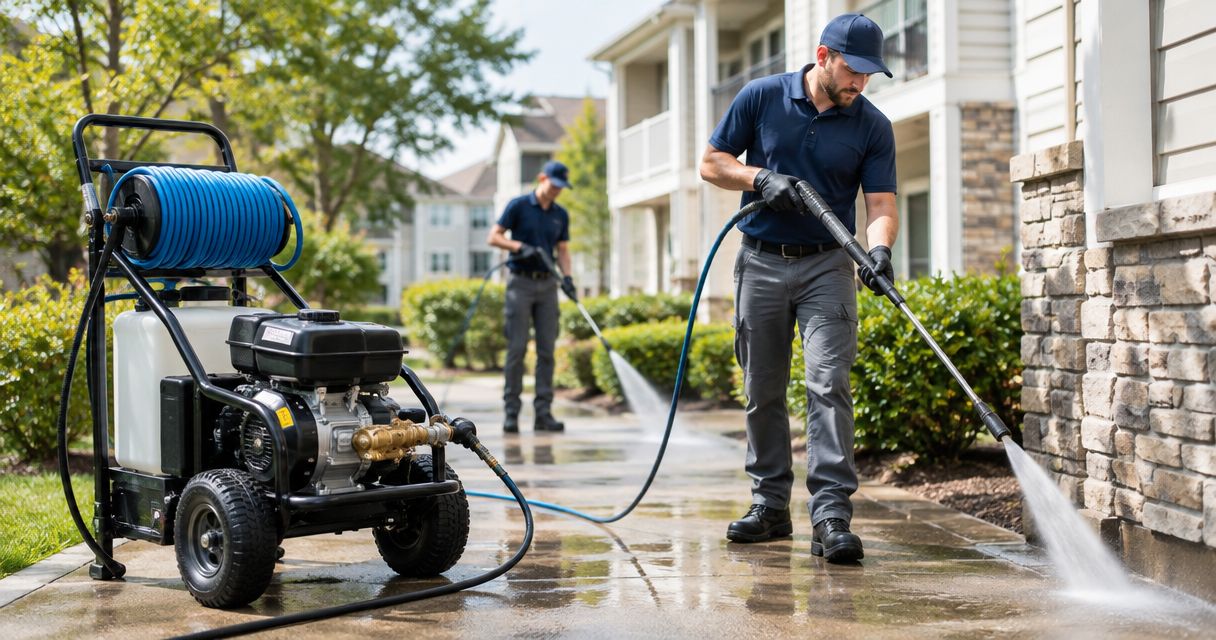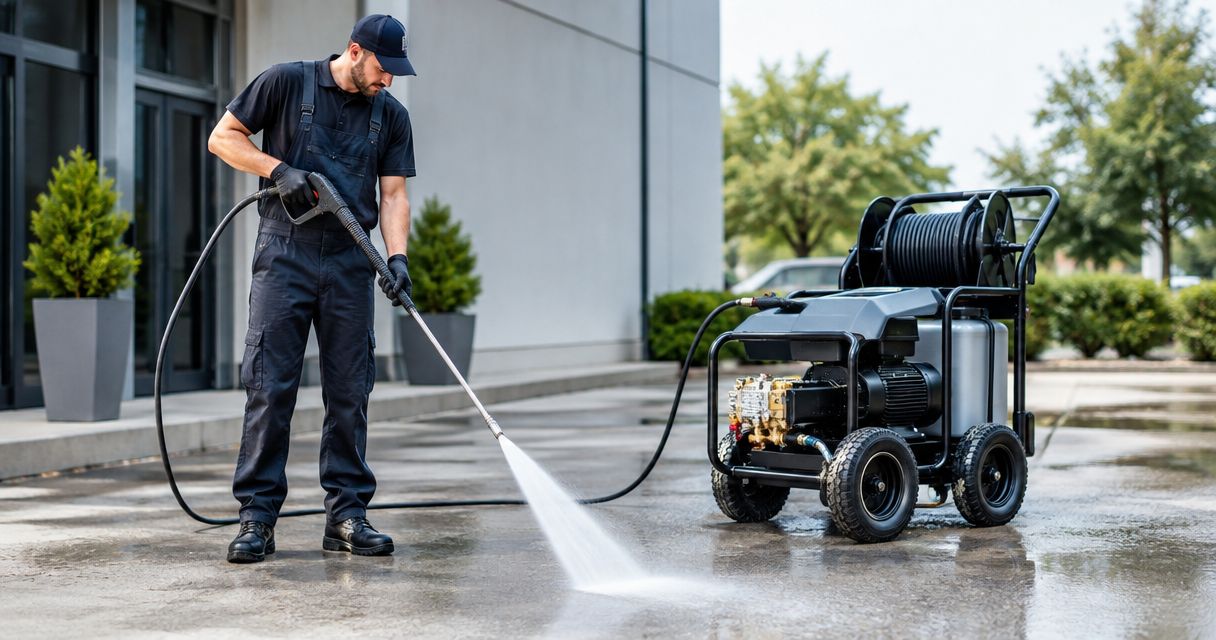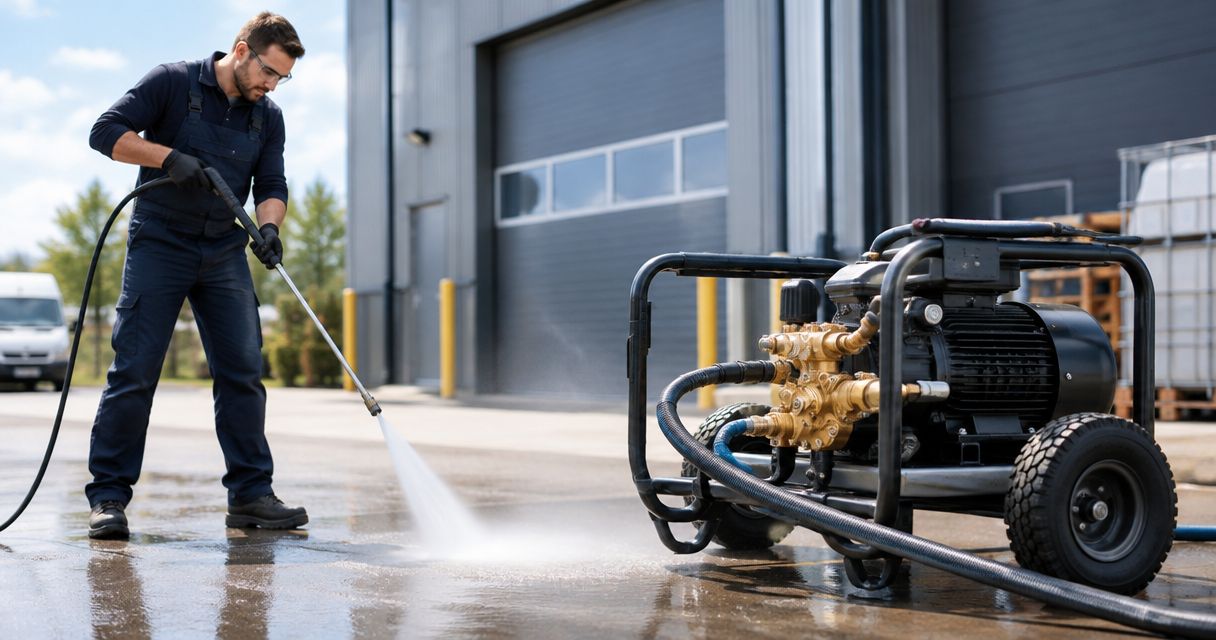
Best overall for sustained commercial work: a belt-drive triplex pump. Best for portable jobs: a direct-drive triplex pump; best for a compact reduction-drive layout: a gear-drive triplex pump. This 2026 guide compares pressure washer pump configurations, explains replacement compatibility, and separates equipment selection from the cleaning method your property needs.
- The best pressure washer pumps for commercial use match the machine’s flow, pressure, drive, and water supply.
- Belt-drive triplex pumps are the default recommendation for sustained commercial pressure washing, subject to machine compatibility.
- Direct-drive triplex pumps suit portable equipment; gear-drive triplex pumps suit compatible reduction-drive layouts.
- Southern Style Soft Wash provides exterior cleaning services, not pump hardware; surface condition determines the appropriate cleaning method.
Why this matters
A pump that fits the shaft is not necessarily a pump that fits the job. Water supply, engine output, operating speed, plumbing, and nozzle selection must work together. A mismatch can leave you with poor cleaning performance or damaged equipment.
For property owners in Troup and Coweta counties, equipment specifications matter less than what happens to the building. Concrete cleaning, house washing, roof cleaning, and specialty stain treatment need different approaches. Buying a powerful pump does not make high pressure appropriate for every surface.
Southern Style Soft Wash is best suited to property owners seeking residential or commercial exterior cleaning services rather than pump hardware. You can review the company's exterior cleaning services before deciding whether this is an equipment purchase or a cleaning-service decision.
What makes the best commercial pressure washer pump?
Use these criteria before comparing pump configurations in 2026. The right choice must fit both the machine and the work, not just offer an appealing pressure rating.
- Flow: Match the pump’s gallons-per-minute rating to the water supply, engine, plumbing, and cleaning attachment. Pressure alone does not describe cleaning capacity.
- Working pressure: Select a rating appropriate for the system and its intended work. The pump, hose, gun, fittings, and unloader must have compatible operating limits.
- Drive compatibility: Confirm mounting pattern, shaft dimensions, rotation, operating speed, and drive arrangement. Similar-looking pumps are not automatically interchangeable.
- Service access: Favor equipment with accessible maintenance points, identifiable replacement parts, and a service manual. A repairable design is only useful when you can obtain its parts.
- Chemical compatibility: Follow the pump manufacturer’s restrictions. Do not assume a pressure washer pump can handle roof-cleaning or house-washing solutions through its internal components.
- Property protection: Choose equipment that supports controlled application and rinsing. The strongest pump is not the best choice if the operator cannot protect the surface and surrounding property.
Commercial pressure washer pumps at a glance
This 2026 ranking compares configurations rather than declaring a universal winning model. A replacement purchase still requires the exact machine and pump specifications.
| Rank and configuration | Best for | Standout feature | Key limitation |
|---|---|---|---|
| Belt-drive triplex pump | Sustained commercial cleaning | Pulley arrangement allows pump speed to differ from engine speed | Requires compatible mounting, belt alignment, and guarding |
| Direct-drive triplex pump | Portable commercial equipment | Compact connection between engine and pump | Pump selection is constrained by engine speed and shaft compatibility |
| Gear-drive triplex pump | Compact reduction-drive installations | Gearbox provides a defined speed relationship without belts | Gearbox compatibility and maintenance add another service consideration |
| Axial-cam replacement pump | Keeping a compatible occasional-use machine working | Preserves the existing machine configuration | Not the default recommendation for a new sustained-use commercial setup |
A triplex plunger pump uses three plungers to move water. Belt drive, direct drive, and gear drive describe how power reaches that pump; they are not separate cleaning methods.
1. Belt-drive triplex pump: best for sustained commercial cleaning
A belt-drive triplex pump receives power through pulleys and belts rather than attaching directly to the engine shaft. The pulley relationship lets the equipment designer select a pump speed different from engine speed. The actual operating speed depends on the complete arrangement.
Best for: A commercial setup designed for repeated concrete, walkway, or other suitable hard-surface cleaning, with enough space for the drive assembly.
Belt-drive triplex pump pros
- The drive arrangement allows pump speed to be selected independently of engine speed.
- A compatible frame can provide clear access to the pump for maintenance.
- Belts are a separate service component rather than part of a direct shaft connection.
- The configuration suits purpose-built equipment when the engine, pump, and plumbing are matched.
Belt-drive triplex pump cons
- Belt tension and pulley alignment need attention.
- The frame must accommodate the drive assembly and suitable guarding.
- Retrofitting an incompatible portable machine is not a simple pump swap.
Before choosing a belt-drive pump in 2026, confirm the required pulley relationship, mounting arrangement, engine capacity, and inlet requirements. Also check whether maintenance access remains practical after the tank, hose reels, and other equipment are installed.
Do not treat belt drive as permission to run without adequate water. Starving the inlet can damage a pump regardless of its drive type. Follow the manufacturer’s water-supply requirements rather than assuming a tank or hose connection is sufficient.
Verdict: Buy for sustained commercial work when the complete machine is designed for belt drive; skip an improvised conversion.
2. Direct-drive triplex pump: best for portable commercial equipment
A direct-drive triplex pump connects to the engine or motor without a belt reduction assembly. This creates a compact arrangement, but it also ties pump selection closely to the power unit’s shaft and operating speed.
Best for: Portable commercial equipment where a smaller drive arrangement and straightforward machine layout matter more than drive-speed flexibility.
Direct-drive triplex pump pros
- The drive assembly does not require belt tensioning or pulley alignment.
- A compact arrangement helps when equipment must be transported between properties.
- A correctly matched replacement preserves the machine’s intended layout.
- A serviceable triplex model offers a maintenance path when appropriate parts are obtainable.
Direct-drive triplex pump cons
- Engine speed and shaft specifications restrict replacement choices.
- A pump that physically mounts can still exceed the engine’s usable capacity.
- Installation space can make access to maintenance points awkward.
Check the shaft diameter, shaft length, key arrangement, bolt pattern, rotation, and rated operating speed before ordering. Then confirm flow and pressure compatibility with the engine and downstream components. Mounting compatibility is only the first check.
A portable machine also needs a suitable water connection at each property. Do not assume every outdoor tap can supply the pump adequately. Confirm supply performance under the conditions in which the equipment will operate.
For property managers, portability helps with access, but it does not determine whether a wall should be pressure washed. Surface condition still controls the cleaning method.
Verdict: Buy for portable commercial jobs when the pump exactly matches the machine; skip replacements chosen by pressure rating alone.
3. Gear-drive triplex pump: best for compact reduction-drive layouts
A gear-drive triplex pump uses a gearbox between the power unit and pump. The gearbox establishes a speed relationship without an exposed belt-and-pulley arrangement. The correct combination depends on the gearbox, pump, and engine specifications together.
Best for: An existing or purpose-built commercial machine that needs a compatible reduction drive in a compact layout.
Gear-drive triplex pump pros
- The gearbox provides a defined relationship between engine and pump speed.
- The configuration avoids belt tension and pulley alignment tasks.
- It offers a reduction-drive option where a belt layout is unsuitable.
- A documented assembly makes the intended engine, gearbox, and pump relationship clear.
Gear-drive triplex pump cons
- The gearbox introduces its own maintenance requirements.
- Replacement selection must account for more than the pump alone.
- A gearbox problem can stop operation even when the pump itself remains serviceable.
For a 2026 replacement, identify the gearbox and its required input and output specifications before selecting the pump. Follow the assembly’s lubrication and inspection instructions. Do not transfer maintenance assumptions from a direct-drive machine.
Gear drive is a layout decision, not a guarantee of better cleaning. A suitable belt-drive or direct-drive machine can perform the same surface-appropriate work when its specifications meet the job requirements.
This configuration makes sense when it solves a real installation constraint. It does not justify replacing a working, properly matched drive system simply to change categories.
Verdict: Buy for a documented, compatible reduction-drive installation; hold until the gearbox and pump specifications are confirmed.
4. Axial-cam replacement pump: best for a compatible legacy machine
An axial-cam pump uses a different mechanism from a triplex plunger pump. For this commercial buying guide, its strongest role is a compatible replacement on an existing machine used occasionally—not the default foundation for sustained commercial work.
Best for: Keeping a suitable existing machine in service for occasional cleaning when its intended workload has not changed.
Axial-cam replacement pump pros
- A correctly specified replacement can preserve the existing machine layout.
- It avoids a drive-system conversion when replacing like for like.
- It keeps the decision focused on the machine’s original operating requirements.
Axial-cam replacement pump cons
- Serviceability varies by model and must be checked before purchase.
- Replacing the pump does not increase the engine’s capacity.
- A compatible fit does not establish suitability for sustained commercial operation.
Read the machine’s documentation and the replacement pump’s service information together. Check whether maintenance and repair are supported, rather than assuming every pump can be rebuilt.
Also reconsider why the old pump failed. An inadequate water supply, incorrect setup, or operation outside the manufacturer’s instructions can damage a replacement too. Repeating the same arrangement without addressing the cause is not a repair strategy.
Verdict: Buy only as a compatible replacement for an appropriate occasional-use machine; skip as the default new commercial setup.
Match the cleaning method to the surface
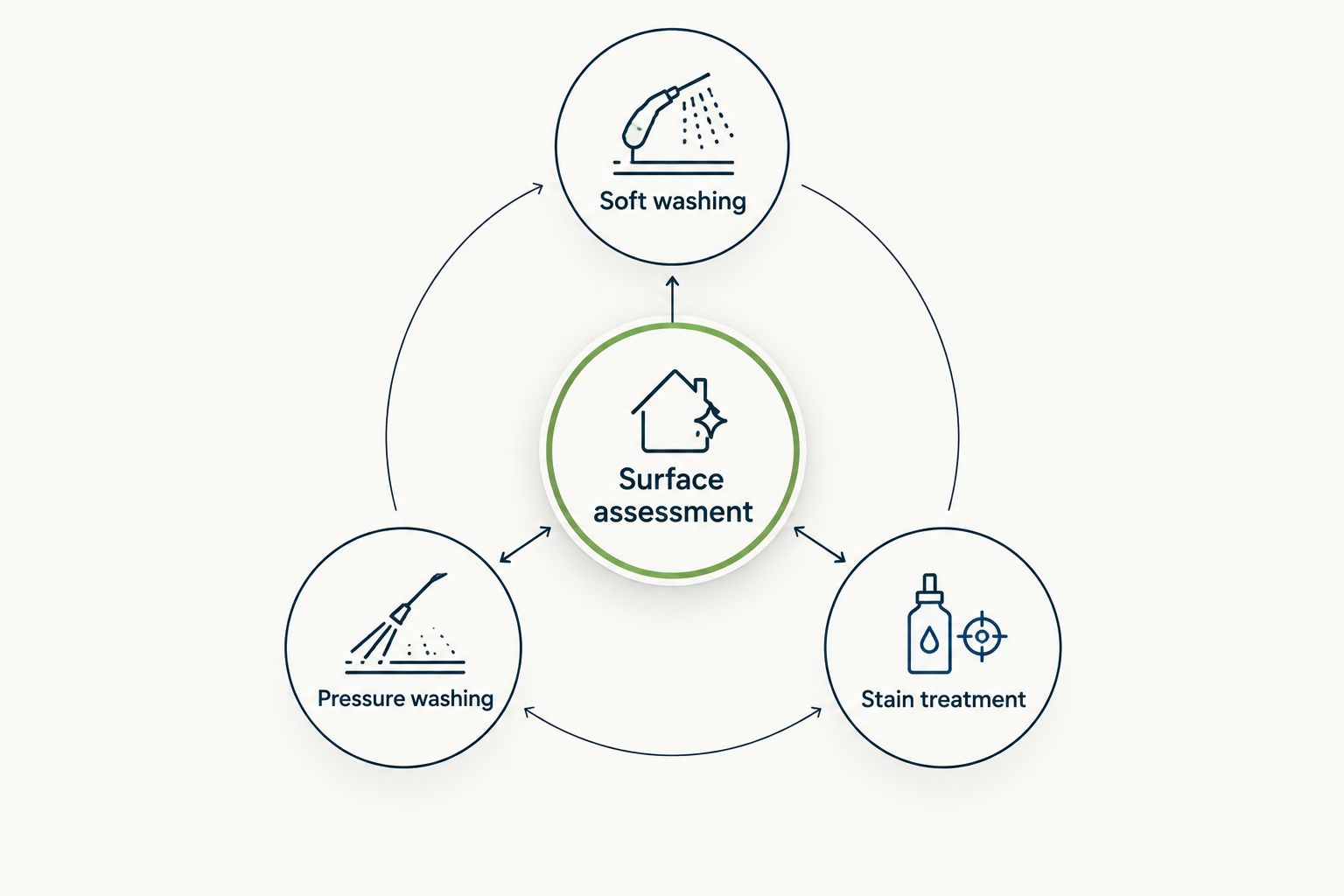
The best pressure washer pumps for commercial use cannot replace sound surface assessment. Southern Style Soft Wash offers house, roof, concrete, and specialty stain cleaning; those service categories are not interchangeable pressure settings.
Use these distinctions when discussing the work:
- Soft washing: Low-pressure application and appropriate chemistry suit tasks where high pressure risks damaging the surface. Roof and siding work require material-specific decisions.
- Pressure washing: Suitable pressure and controlled technique can clean sound concrete and other appropriate hard surfaces. Existing deterioration still matters.
- Stain treatment: Rust, red clay, and oil require stain-specific assessment. Increasing pressure does not substitute for selecting an appropriate treatment.
Ask how the operator will protect landscaping before cleaning begins. Appropriate steps include wetting nearby plants, controlling overspray, rinsing exposed foliage, and using a suitable neutralizer where the chemistry and site conditions call for it. Sodium hypochlorite is an oxidizing ingredient used in some exterior-cleaning solutions; its presence makes application control and plant protection important.
For older homeowners, discuss porch furniture, planters, access routes, and trip hazards before the appointment. Agree on who will move heavier objects. Preparation should not require the homeowner to do unsafe lifting.
No responsible contractor can promise zero risk or complete removal of every stain. Deep discoloration, weathered coatings, and damaged materials can remain after cleaning. Improvement and guaranteed removal are different outcomes.
How the pump configurations were ranked
The ranking prioritizes drive suitability, compatibility, service access, and the ability to support the intended workload. Belt-drive triplex is the default for a planned sustained-use setup; direct drive wins the portable slot; gear drive addresses a compact reduction-drive requirement.
Axial-cam replacement remains a conditional choice for an existing machine. This is a configuration guide, not a claim that every model within a category performs equally.
Which commercial pressure washer pump should you choose?
Choose a belt-drive triplex pump for a new sustained-use commercial setup when the machine supports it. Choose a direct-drive triplex replacement for compatible portable equipment, and a gear-drive triplex pump when the documented installation requires that arrangement.
Before buying in 2026, match the complete specification sheet: drive, shaft, speed, flow, pressure, engine requirements, and water supply. If you own property rather than cleaning equipment, focus on the contractor’s surface assessment and protection plan instead.
Discuss your exterior cleaning needs
Review house, roof, concrete, and specialty stain cleaning for your property.
FAQ
What are the best pressure washer pumps for commercial use?
A properly matched triplex pump is the default recommendation for commercial pressure washing. Belt drive suits sustained-use installations, direct drive suits portable equipment, and gear drive suits compatible reduction-drive layouts.
Is a belt-drive pump better than a direct-drive pump?
Belt drive is the better fit when a commercial setup needs pump-speed flexibility and has room for the drive assembly. Direct drive is the better fit when compactness and compatibility with portable equipment are the priorities.
Can I replace my pressure washer pump with a higher-pressure model?
A higher-pressure pump is not automatically a compatible replacement. Confirm the engine capacity, drive specifications, flow, unloader, hoses, gun, and fittings before changing the pump.
Does more pressure mean faster cleaning?
More pressure alone does not establish faster or safer cleaning. Flow, nozzle selection, surface condition, chemistry, and technique also determine the result.
Can a commercial pressure washer pump be used for roof cleaning?
Owning a commercial pressure washer pump does not make high-pressure roof cleaning appropriate. Roof material and condition determine the method, and asphalt shingles generally require a low-pressure approach consistent with manufacturer guidance.
Should cleaning chemicals pass through the pressure washer pump?
Only use chemicals through a pump when its manufacturer expressly permits that application. A chemical injector or separate application system must also be compatible with the solution and the complete equipment arrangement.
Does Southern Style Soft Wash sell commercial pressure washer pumps?
Southern Style Soft Wash provides residential and commercial exterior cleaning services, rather than serving as a pump recommendation in this equipment ranking. Its stated services include house, roof, concrete, and specialty stain cleaning.
One last thing
Record the failed pump’s model and the machine’s specifications before removing anything. Photograph the mounting, plumbing, and drive arrangement, then investigate the failure cause. A replacement pump solves a failed component; it does not solve inadequate water supply or an incompatible system.