Best overall for applying house-wash detergent: a low-pressure soap nozzle. Best for rinsing compatible siding: a 40-degree fan nozzle. Best for a dedicated soft-wash system: a system-matched soft-wash nozzle. The best pressure washer nozzles for house washing in 2026 match the surface, cleaning task, and equipment—not simply the widest spray angle.
- The best pressure washer nozzles for house washing separate low-pressure detergent application from surface-appropriate rinsing.
- Choose a low-pressure soap nozzle for detergent application, not for removing stubborn stains with force.
- A 40-degree fan spreads the spray; it does not automatically make a pressure washer safe for siding.
- Southern Style Soft Wash offers house washing; choose professional help when access or surface condition complicates cleaning.
Why this matters
A nozzle changes the spray pattern, but the machine, nozzle opening, working distance, and surface condition also determine how that spray behaves. A wide fan can still force water behind siding or damage a deteriorated finish.
Southern Style Soft Wash provides residential and commercial exterior cleaning in LaGrange, Newnan, Valley, and surrounding West Georgia and East Alabama communities. For homeowners and commercial property owners in Troup and Coweta counties, the useful buying question is not which tip cleans hardest. It is which setup cleans the surface without using unnecessary force.
Southern Style Soft Wash is best for property owners who want professional house washing rather than choosing and operating their own nozzle setup.
What makes the best house-washing nozzle
Use these criteria to choose your house-washing setup in 2026:
- Surface compatibility: Follow the siding, coating, or masonry manufacturer's cleaning instructions before choosing a tip.
- Equipment compatibility: Match the connection, pressure rating, flow requirements, and nozzle opening to your equipment.
- Application versus rinsing: Detergent application and rinsing are different tasks; one nozzle does not necessarily handle both correctly.
- Spray control: Choose a pattern you can direct away from siding seams, vents, electrical fixtures, and people.
- Safe access: Select equipment you can control from stable ground. A longer-reaching spray does not solve every access problem.
- Stain diagnosis: Organic growth, red clay, rust, and oil need different treatment decisions—not progressively narrower tips.
Best house-washing nozzles at a glance
These are nozzle categories, not a ranking of unverified brands. Compatibility with your equipment determines the final selection.
| Rank and nozzle | Best for | Standout feature | Key limitation |
|---|---|---|---|
| 1. Low-pressure soap nozzle | Applying compatible detergent | Supports detergent application on compatible injector systems | Does not replace a suitable rinse setup |
| 2. 40-degree fan nozzle | Controlled rinsing of compatible siding | Broad fan distributes the spray | Wide angle does not guarantee low pressure |
| 3. System-matched soft-wash nozzle | Dedicated low-pressure cleaning equipment | Matches the application system rather than a pressure-washer color chart | Not automatically interchangeable with pressure-washer tips |
| 4. Adjustable multi-pattern nozzle | Changing patterns during mixed exterior tasks | Keeps selectable patterns in one attachment | Wrong settings remain easy to select |
| 5. 25-degree fan nozzle | Approved cleaning of sound masonry accents | More concentrated fan than a 40-degree tip | Not a default choice for siding, roofs, or weak mortar |
1. Low-pressure soap nozzle: best for detergent application
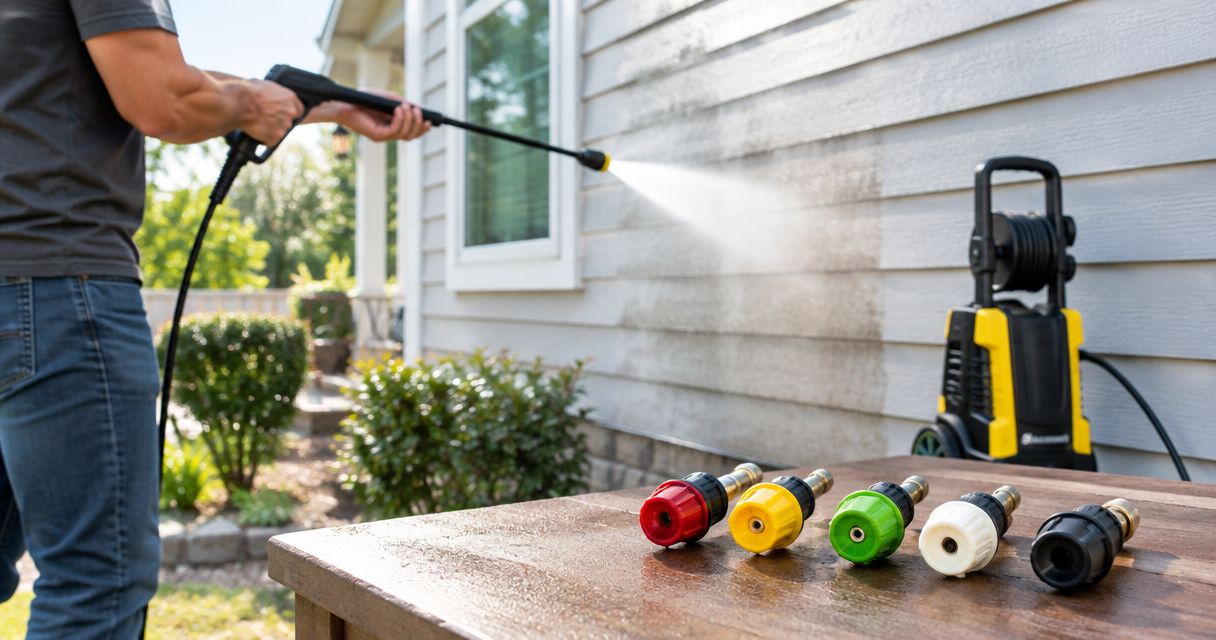
A low-pressure soap nozzle is the first choice when your pressure washer uses a compatible detergent injector. On many consumer machines, the soap tip is black, but the equipment manual—not color alone—determines its function.
The nozzle helps the injector draw detergent under the required operating conditions. It does not turn every pressure washer into a dedicated soft-wash system, and it does not make every cleaning chemical suitable for the machine.
Low-pressure soap nozzle pros:
- Separates detergent application from forceful cleaning.
- Provides a recognizable application setting on compatible equipment.
- Lets you apply a suitable cleaner before deciding whether further treatment is needed.
Low-pressure soap nozzle cons:
- Detergent pickup depends on the injector, hose configuration, and equipment instructions.
- The application tip is not necessarily suitable for the final rinse.
Best for: Homeowners applying an equipment-approved house-wash cleaner through a compatible injector.
Verdict: Buy a compatible soap nozzle for detergent application; do not expect it to solve rinsing or stain removal by itself.
2. 40-degree fan nozzle: best for controlled siding rinsing
A 40-degree fan nozzle spreads water across a broader pattern than a 25-degree tip. It is commonly identified by a white tip, although you should verify the angle and specifications rather than rely on color.
For house washing in 2026, this is the pressure-washer rinse option to evaluate before narrower fans. Approval still depends on the surface manufacturer's instructions, machine output, nozzle sizing, and an inconspicuous test area.
40-degree fan nozzle pros:
- Provides a broad rinse pattern.
- Makes overlapping passes easier to manage than a concentrated jet.
- Keeps rinsing separate from detergent application.
40-degree fan nozzle cons:
- Can still damage siding or force water into openings.
- Does not compensate for an oversized machine or unsuitable nozzle opening.
Best for: Rinsing surfaces whose manufacturer permits the proposed pressure-washing method.
Keep the spray directed away from laps, gaps, and vulnerable fixtures. Do not move closer simply because a stain remains; diagnose the stain instead.
Verdict: Buy only after confirming that the complete rinse setup is appropriate for your siding.
3. System-matched soft-wash nozzle: best for dedicated equipment
A dedicated soft-wash nozzle works with its intended low-pressure delivery system. Unlike a pressure-washer fan tip selected mainly by spray angle, this choice starts with the system manufacturer's guidance on flow, connections, materials, and chemical compatibility.
Low-pressure soft washing uses cleaning chemistry to loosen or treat contamination rather than relying on concentrated impact. That distinction matters for house exteriors and especially for roof-cleaning decisions.
System-matched soft-wash nozzle pros:
- Supports a low-pressure application approach.
- Matches the delivery equipment's intended operation.
- Allows application and rinse choices to follow system instructions.
System-matched soft-wash nozzle cons:
- Requires compatible equipment; the nozzle alone is not a conversion kit.
- Chemical handling and overspray protection still require care.
Best for: Operators who already have a dedicated soft-wash system and understand its instructions.
A pressure washer fitted with a broad fan is not automatically equivalent to dedicated low-pressure equipment. Avoid purchasing a nozzle based on the words soft wash without checking how the entire system operates.
Verdict: Buy the manufacturer-specified nozzle for an existing soft-wash system; hold off on improvised conversions.
4. Adjustable multi-pattern nozzle: best for changing exterior tasks
An adjustable multi-pattern nozzle places selectable spray patterns in one attachment. That can simplify transitions between suitable tasks around a property, provided its available settings and ratings match your machine.
Convenience is its main advantage—not extra protection for siding. Verify the selected position before spraying, and follow the equipment instructions when changing settings.
Adjustable multi-pattern nozzle pros:
- Reduces handling of separate tips during pattern changes.
- Keeps several listed spray settings in one attachment.
- Helps organize mixed tasks when each surface has a defined setting.
Adjustable multi-pattern nozzle cons:
- A mistaken selection can expose a delicate surface to a concentrated spray.
- Settings, connections, and chemical suitability vary by model.
Best for: Experienced users switching between clearly separated, approved exterior-cleaning tasks.
For your 2026 buying decision, choose this category only if you can identify each setting reliably. A simpler fixed nozzle is preferable when extra choices make the job harder to control.
Verdict: Hold unless pattern changes genuinely help your work; skip it if you cannot verify the setting before every pass.
5. 25-degree fan nozzle: best for sound masonry accents
A 25-degree fan concentrates the spray more than a 40-degree nozzle. It is commonly green and belongs in a separate decision category from routine siding washing.
Sound masonry can tolerate cleaning approaches that painted trim or vulnerable siding cannot. But brick condition, mortar joints, coatings, and surface deterioration must be assessed before selecting pressure.
25-degree fan nozzle pros:
- Offers a more focused fan for approved masonry work.
- Lets you keep masonry cleaning separate from broad siding rinsing.
- Provides a fixed pattern whose purpose is easy to identify.
25-degree fan nozzle cons:
- Can damage weak mortar, coatings, and deteriorated masonry.
- Is not a substitute for specialty treatment of rust, clay, or oil.
Best for: Specific, manufacturer-approved cleaning of sound masonry features—not general house washing.
Concrete driveways, brick steps, and house siding should not inherit the same nozzle choice merely because they sit on the same property.
Verdict: Buy only for a defined, suitable masonry task; skip it as your default house-washing tip.
What to skip for routine house washing
Skip zero-degree jets and rotating turbo nozzles for routine siding washing. A zero-degree tip produces a concentrated stream; a turbo nozzle rotates a concentrated jet. Neither becomes a gentle house-washing choice because it removes dirt quickly.
A 15-degree fan is also more concentrated than the broader options discussed here. Do not treat narrowing the spray as the next step when cleaning stalls.
These tools have task-specific uses, but they do not belong in a default siding-cleaning recommendation. Roofs deserve a separate assessment: do not carry a concrete-cleaning setup onto asphalt shingles.
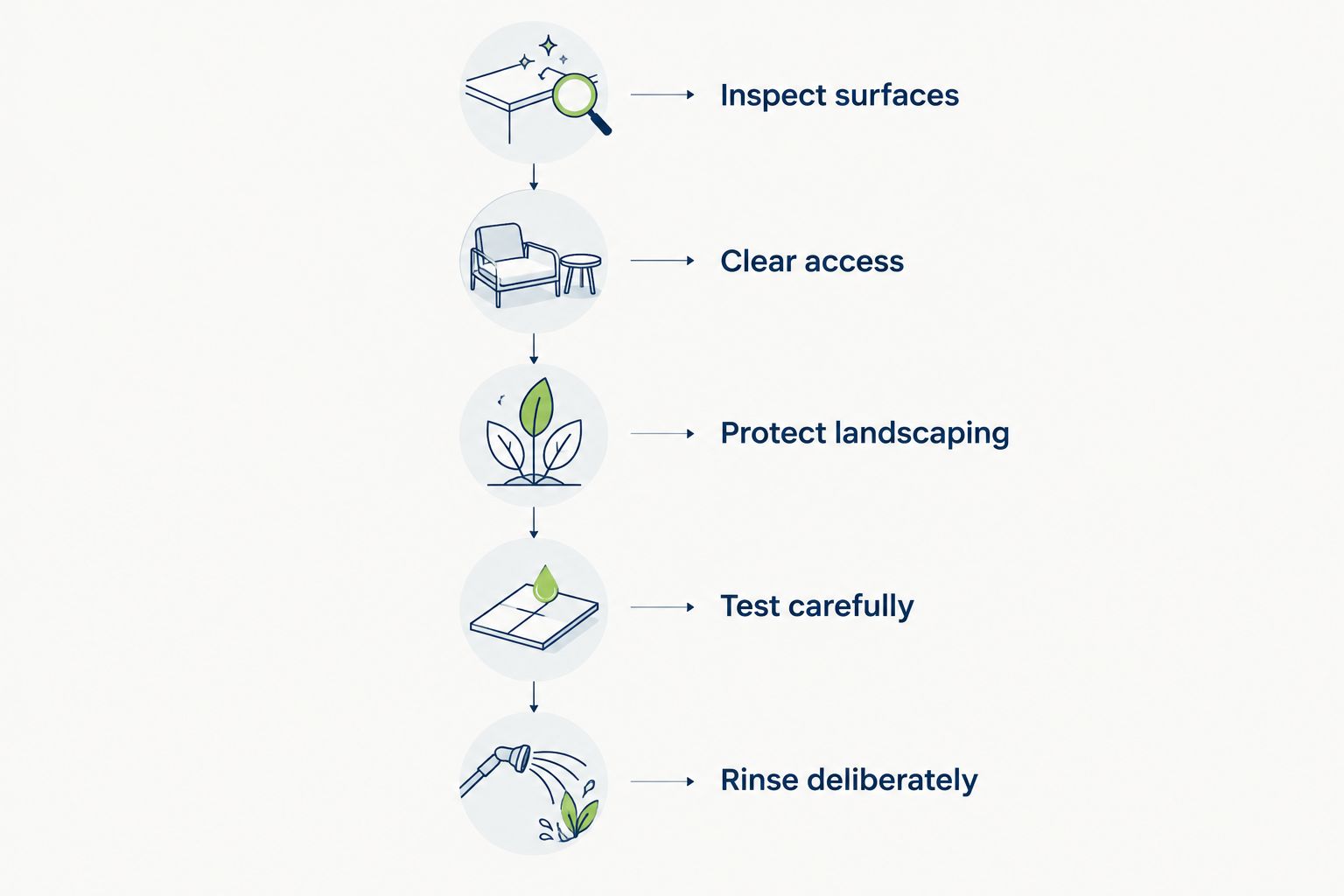
Prepare the property before selecting the final setting
A sensible 2026 house-washing plan starts with inspection and protection, not the trigger. Use this sequence for a home, storefront, or other occupied property.
Inspect surfaces
Check loose siding, failed caulk, damaged paint, deteriorated mortar, and openings around fixtures. Photograph existing problems and identify anything that needs repair before washing.
Clear access
Move lightweight porch furniture, mats, and decorations away from the work area. Older homeowners should arrange help with heavy items rather than lifting them or leaving obstacles in the operator's path.
Protect landscaping
Pre-rinse nearby plants when the cleaning method calls for it, control overspray, and rinse exposed landscaping afterward. Use a suitable neutralizer only where appropriate and according to its instructions; never improvise chemical mixtures.
Test carefully
Check an inconspicuous area using the approved method before treating the visible wall. Stop if the finish changes, material loosens, or water enters an unintended opening.
Rinse deliberately
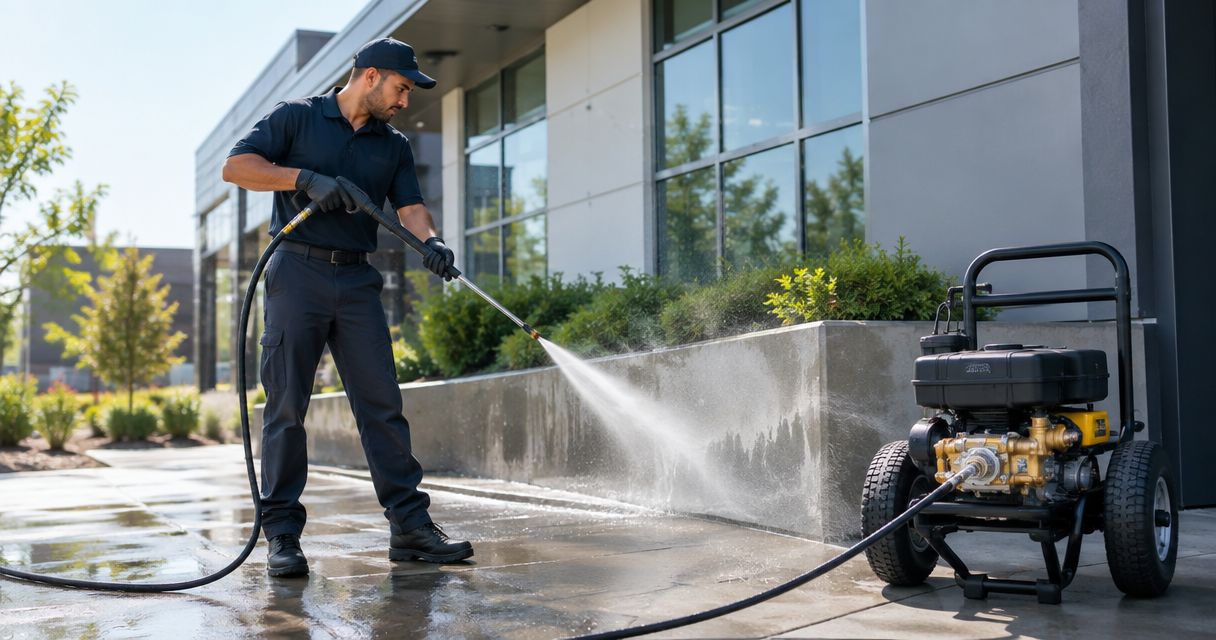
Keep the spray away from electrical fixtures, vents, and siding gaps. For commercial entrances, separate the work area from pedestrians and coordinate access before cleaning starts.
Match the chemistry to the stain
House washing, roof cleaning, concrete cleaning, and specialty stain treatment are different jobs. Choosing a nozzle does not settle the chemistry question.
Sodium hypochlorite is used in exterior cleaning to treat organic growth. Its suitability depends on the surface, formulation, application method, and equipment instructions; do not feed it through components whose manufacturer prohibits it.
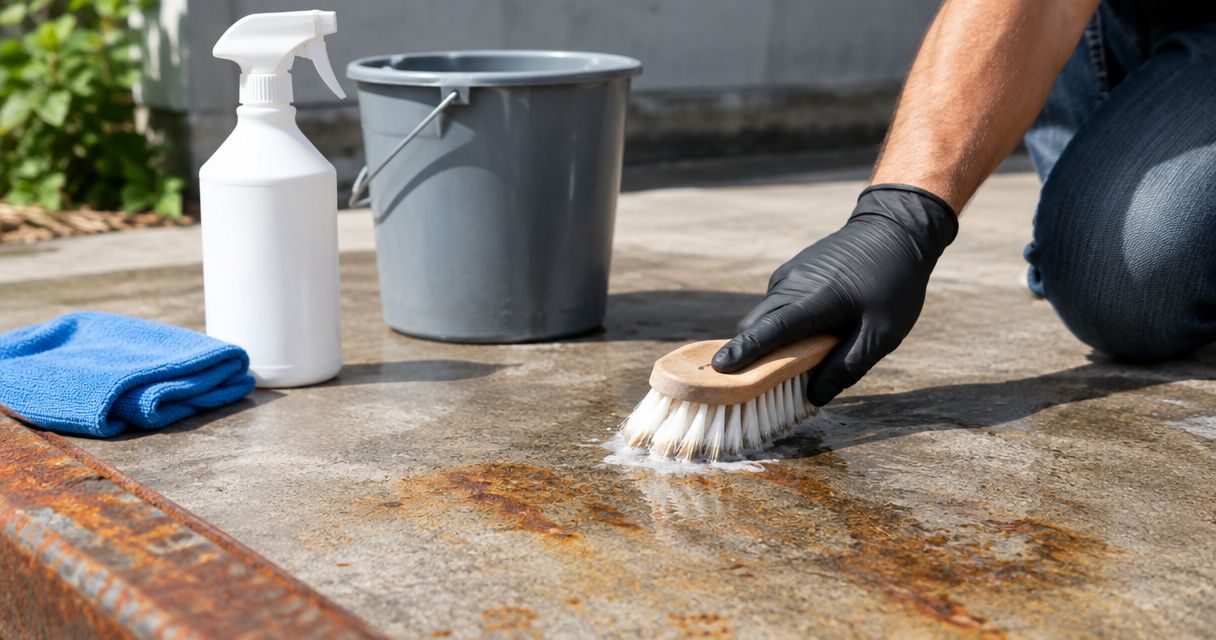
Red clay, rust, and oil require their own treatment decisions. A stronger jet can damage the surface without resolving the underlying stain. Never mix sodium hypochlorite with acids or ammonia, and follow chemical labels for handling and protection.
Set realistic expectations before work begins. Weathering, oxidation, damaged coatings, and absorbed stains can remain after cleaning; improvement is not a promise of complete removal. No responsible contractor can promise zero risk.
How these nozzle categories are ranked
The 2026 ranking prioritizes task fit, surface compatibility, equipment compatibility, and operator control. Low-pressure detergent application comes first because it separates cleaning chemistry from force; broad rinsing follows only where the surface permits it.
This is a task-based buying guide, not a claim of laboratory testing or a brand performance comparison. Adjustable patterns and narrower fans rank lower because their usefulness depends on more specific circumstances.
Which house-washing nozzle should you choose?
Choose a compatible low-pressure soap nozzle for application, then select a separate rinse method that the surface manufacturer permits. Evaluate a 40-degree fan for approved pressure-washer rinsing; choose a system-matched nozzle if you already use dedicated soft-wash equipment.
If you cannot reach the surface safely, identify the stain, or confirm compatibility, stop before buying a more aggressive attachment. Southern Style Soft Wash offers house, roof, concrete, and specialty stain cleaning for residential and commercial properties.
Discuss your exterior cleaning needs
Describe the surface, staining, and access concerns before choosing a cleaning approach.
FAQ
What's the best pressure washer nozzle for house washing?
A compatible low-pressure soap nozzle is the first choice for detergent application; rinsing requires a separate surface-approved setup. A 40-degree fan is an option to evaluate, not an automatic safety guarantee.
Is a white nozzle safe for vinyl siding?
A white nozzle is not automatically safe for vinyl siding. Verify its actual spray angle, machine compatibility, working method, and the siding manufacturer's cleaning instructions.
Can I soft wash my house with a pressure washer?
Some pressure washers support low-pressure detergent application through compatible injectors. That does not make the entire machine equivalent to a dedicated soft-wash system, and the rinse method still needs separate approval.
Should I use a turbo nozzle on house siding?
Skip a turbo nozzle for routine house-siding washing. Its rotating concentrated jet is not a substitute for suitable chemistry and controlled rinsing.
Why won't my soap nozzle draw detergent?
Detergent pickup depends on the injector's required operating conditions. Check the equipment manual for nozzle, hose, filter, and injector requirements before changing parts.
Can the same nozzle clean my roof and driveway?
Do not assume that a driveway-cleaning nozzle is suitable for your roof. Roof material and manufacturer instructions require a separate cleaning decision, especially for asphalt shingles.
Will a stronger nozzle remove every exterior stain?
A stronger nozzle does not guarantee stain removal. Rust, red clay, oil, oxidation, and surface damage need different assessments, and some marks improve without disappearing completely.
One last thing
Before purchasing a replacement nozzle, check its opening and equipment rating—not just its color or spray angle. Two tips with the same fan angle are not necessarily interchangeable. The right method for the surface matters more than owning every nozzle.