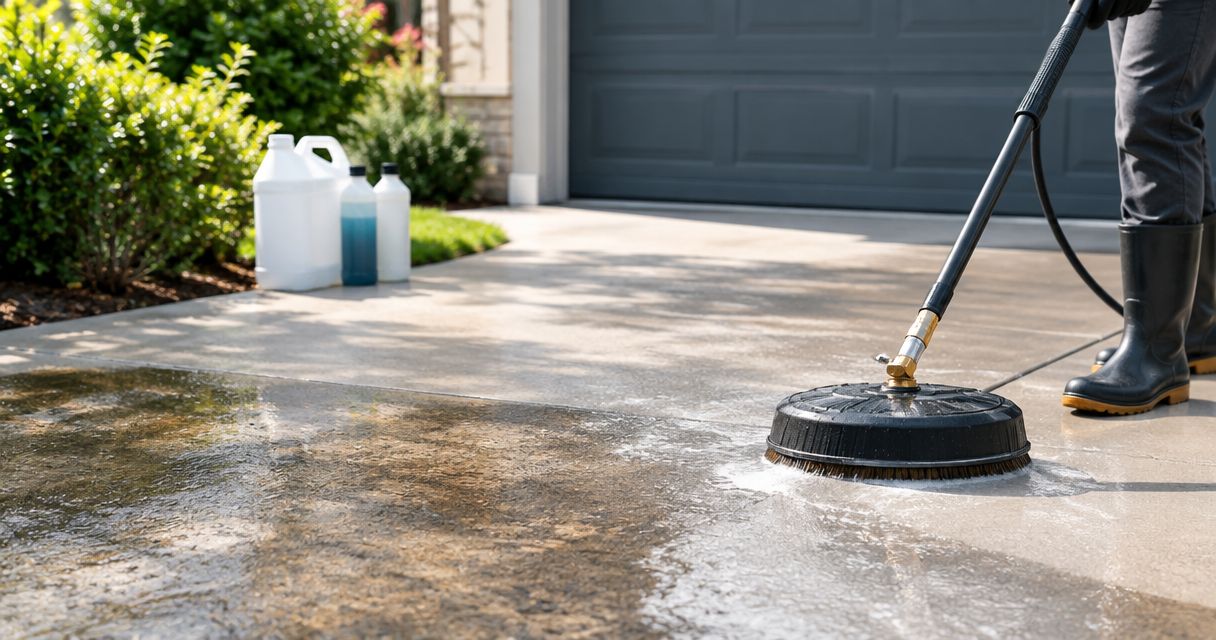
Best overall: professional, surface-matched concrete cleaning. Best for oil: a concrete-compatible alkaline degreaser. Best for routine dirt: a concrete-compatible detergent. This 2026 guide explains which driveway stains each approach treats, where it falls short, and when to ask Southern Style Soft Wash for an assessment.
- The best concrete cleaner for driveways matches the stain and the concrete’s condition, not just the equipment available.
- Southern Style Soft Wash offers concrete cleaning and specialty stain services for residential and commercial property owners.
- Choose an alkaline degreaser for oily residue, sodium hypochlorite treatment for organic growth, and dedicated treatments for mineral stains.
- Protect landscaping, control runoff, and test the treatment before cleaning the whole driveway.
Why this matters
A driveway can hold several problems at once: tire residue, oil, organic growth, rust, and red clay. One cleaner does not address all of them. Removing surface dirt also does not establish that a deeper stain has disappeared.
For homeowners and commercial property owners in Troup and Coweta counties, the useful question in 2026 is not which bottle sounds strongest. It is which treatment fits the stain without unnecessarily stressing the concrete, nearby plants, or adjoining finishes.
Southern Style Soft Wash is best suited to driveway owners seeking professional concrete cleaning and specialty stain assessment. The company serves residential and commercial property owners in LaGrange, Newnan, Valley, and surrounding West Georgia and East Alabama areas.
What makes the best concrete cleaner for driveways?
Use these criteria to choose a driveway-cleaning approach in 2026:
- Stain match: Oil, organic growth, rust, and clay require different cleaning chemistry.
- Surface compatibility: Bare concrete, sealed concrete, decorative finishes, and deteriorating surfaces need separate checks.
- Controlled application: Follow the product label for dilution, dwell time, agitation, and rinsing rather than improvising a stronger mixture.
- Property protection: Plan landscaping rinsing, nearby-surface protection, pedestrian access, and runoff control before application.
- Honest limitations: Prefer a treatment with clear boundaries over a promise to erase every mark.
Do not choose by pressure alone. Water pressure helps remove loosened material, but excessive force can damage a surface without solving the stain underneath.
Driveway concrete cleaners at a glance
| Cleaning approach | Best for | Standout feature | Key limitation |
|---|---|---|---|
| Professional surface-matched cleaning | Mixed stains or uncertain concrete condition | Combines inspection, suitable chemistry, and controlled washing | Cannot guarantee complete stain removal |
| Concrete-compatible alkaline degreaser | Oil and greasy residue | Targets oily contamination | Deep oil staining can remain |
| Sodium hypochlorite treatment | Algae and other organic growth | Treats organic contamination rather than just rinsing it | Requires careful handling and plant protection |
| Dedicated concrete rust remover | Orange or brown rust marks | Targets iron-related staining | Not a general driveway cleaner |
| Dedicated red clay cleaner | Clay discoloration | Addresses clay staining beyond loose surface soil | Requires compatibility checks and controlled application |
| Concrete-compatible detergent | Routine dirt and light surface soil | Supports straightforward maintenance cleaning | Does not replace specialty stain treatments |
The ranking separates use cases rather than declaring one chemical universally strongest. Start with the stain category, then check whether your concrete can tolerate the proposed treatment.
1. Professional surface-matched cleaning: best for mixed stains
Professional driveway cleaning is the strongest default when you cannot confidently identify the stain or assess the concrete. The work should begin with inspection, not immediate spraying. A driveway with oil near the garage, organic growth beside a shaded wall, and rust beneath metal furniture needs a treatment plan rather than one blanket application.
Southern Style Soft Wash offers concrete cleaning and specialty stain services. Before scheduling, ask how the proposed work distinguishes general washing from stain-specific treatment and what improvement is realistic.
Professional surface-matched cleaning pros:
- Addresses different stain types within the same cleaning plan.
- Allows the washing method to reflect the concrete’s condition.
- Brings access, landscaping, and runoff into the preparation discussion.
Professional surface-matched cleaning cons:
- Does not guarantee removal of deeply absorbed discoloration.
- Requires a clear scope so general cleaning and specialty treatment are not confused.
- Existing damage can limit what cleaning safely achieves.
Best for: Homeowners and commercial property owners with mixed contamination, delicate adjoining surfaces, or uncertain concrete condition.
Verdict: Choose professional assessment before treating an unfamiliar stain or compromised surface.
2. Alkaline degreaser: best for driveway oil and grease
A concrete-compatible alkaline degreaser helps loosen oily contamination so it can be removed. It belongs on the shortlist for greasy patches near parking spaces or garage entrances. The label must explicitly support the surface and intended use.
Remove loose debris and address accessible oil residue before applying cleaner. Follow the specified dilution and dwell instructions; letting a treatment dry on the surface is not a substitute for giving it the recommended working time.
Alkaline degreaser pros:
- Matches the chemistry to oily residue.
- Allows localized treatment instead of unnecessary whole-driveway application.
- Works with label-directed agitation and rinsing.
Alkaline degreaser cons:
- Does not substitute for rust or organic-growth treatment.
- Cannot promise to extract oil that has penetrated deeply.
- Requires careful collection or control of contaminated wash water.
Best for: Identifiable oil and grease contamination on compatible concrete.
Verdict: Choose a concrete-compatible degreaser for oil; skip it as a universal stain remover.
3. Sodium hypochlorite treatment: best for organic growth
Sodium hypochlorite is used in exterior cleaning to treat organic contamination, including algae. On a compatible driveway surface, suitable chemistry can reduce reliance on aggressive pressure. It is not the same treatment as an oil degreaser or mineral-stain remover.
Look beyond the green or dark patch before application. Nearby landscaping, metal, clothing, and adjoining finishes all need attention, and the product’s handling instructions remain essential.
Sodium hypochlorite treatment pros:
- Targets organic growth rather than only dislodging visible material.
- Supports chemistry-led cleaning with surface-appropriate pressure.
- Can address organic contamination in textured concrete when used correctly.
Sodium hypochlorite treatment cons:
- Can harm plants or affect nearby materials without suitable protection.
- Does not resolve every dark mark, especially nonorganic staining.
- Must never be mixed with acids, ammonia, or unrelated cleaners.
Best for: Confirmed organic growth on concrete compatible with the treatment.
Verdict: Choose a controlled organic-growth treatment, not an improvised bleach mixture.
4. Dedicated concrete rust remover: best for rust stains
A dedicated rust remover addresses iron-related discoloration rather than ordinary dirt. Orange or brown marks beneath metal objects are a reason to investigate rust, not proof that every similarly colored stain has the same cause.
Some rust-removal formulations are acidic. Concrete compatibility matters because an unsuitable treatment can alter the surface while attempting to remove the stain. Check the label and test discreetly before broader application.
Concrete rust remover pros:
- Targets a stain that general washing often leaves behind.
- Supports spot treatment of isolated marks.
- Makes the distinction between mineral staining and surface dirt explicit.
Concrete rust remover cons:
- Incorrect chemistry can etch concrete or affect a decorative finish.
- Requires separation from incompatible cleaners, especially sodium hypochlorite.
- Does not prevent another stain if the rust source remains.
Best for: Identified rust staining on a surface approved by the product label.
Verdict: Choose a concrete-specific rust treatment; skip stronger pressure as the default response.
5. Dedicated red clay cleaner: best for clay discoloration
Red clay can leave more than a layer of loose dirt. Start by distinguishing removable soil from discoloration that remains after ordinary cleaning. A dedicated treatment belongs in the plan when general washing does not address the remaining clay stain.
The term red clay cleaner does not establish that a product suits every concrete surface. Check its directions, finish compatibility, rinsing requirements, and any neutralization instructions before use.
Red clay cleaner pros:
- Matches treatment to clay-related staining.
- Allows attention to affected edges and runoff paths.
- Separates ordinary soil removal from specialty stain work.
Red clay cleaner cons:
- Can require additional precautions beyond routine washing.
- Does not solve continuing soil runoff onto the driveway.
- Cannot guarantee that longstanding discoloration disappears completely.
Best for: Persistent red clay discoloration after loose soil has been removed.
Verdict: Choose a label-approved clay treatment after identifying the stain; skip indiscriminate chemical application.
6. Concrete-compatible detergent: best for routine driveway dirt
A concrete-compatible detergent is the simplest category to consider for routine dirt and light surface soil. It helps loosen contamination before brushing or suitable washing. Choose a formulation whose label covers your concrete and any existing coating.
Routine cleaning does not require turning every mark into a specialty-treatment project. Begin with the least aggressive suitable approach, then reassess what remains after the surface dries.
Concrete-compatible detergent pros:
- Fits ordinary maintenance rather than specialty stain removal.
- Supports brushing and controlled rinsing.
- Provides a straightforward starting point when the surface is sound and the dirt is superficial.
Concrete-compatible detergent cons:
- Usually needs a separate approach for persistent oil, rust, or clay.
- Still requires compatibility checks on sealed or decorative concrete.
- Washing alone does not repair cracks, flaking, or worn finishes.
Best for: Sound, compatible concrete with routine surface dirt.
Verdict: Choose detergent for maintenance; skip repeated applications when the remaining mark needs another treatment.
Prepare the driveway before choosing equipment
A pressure washer is equipment, not a diagnosis. A surface cleaner attachment distributes washing across a defined area, but the attachment does not make excessive pressure safe. Low-pressure soft washing uses chemistry and gentle application; suitable pressure washing removes loosened material from surfaces that can tolerate it.
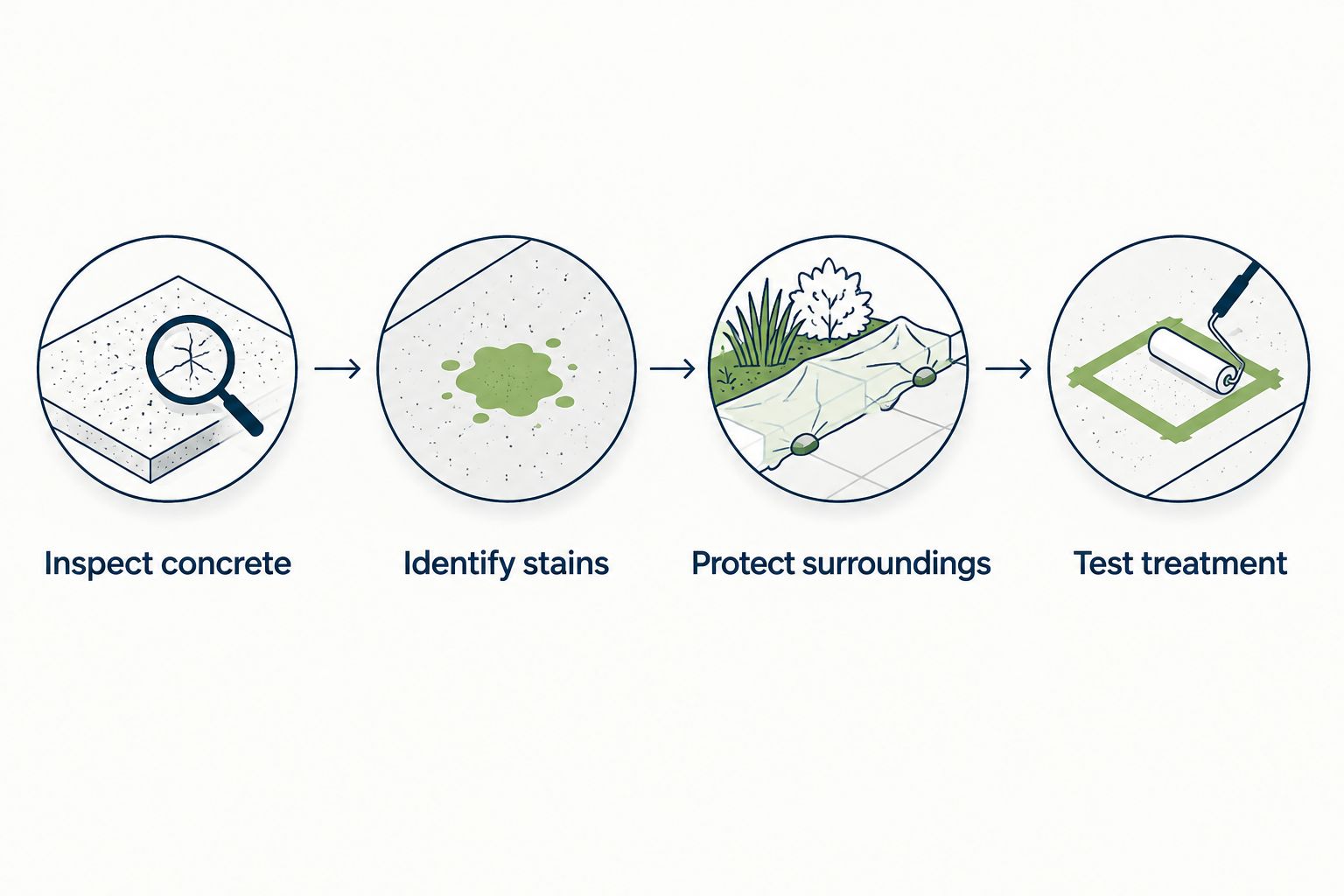
Use this preparation sequence before driveway cleaning:
- Inspect concrete: Check for loose material, cracks, damaged edges, coatings, and adjoining surfaces that need protection.
- Identify stains: Separate oil, organic growth, rust, clay, and routine dirt rather than treating the driveway as one uniform problem.
- Protect surroundings: Move accessible furniture, manage hoses and pedestrian routes, plan landscaping rinsing, and control runoff.
- Test treatment: Check a discreet area using the intended cleaner and method before expanding the work.
The sequence matters because a test result is only useful after the surface and stain have been identified. Choose the method before increasing the pressure.
Ask 3 questions before work begins: What is the stain? What condition is the surface in? Where will the wash water go? These questions keep equipment selection tied to the property rather than habit.
For older homeowners, preparation should include agreeing who moves porch furniture, planters, and other obstacles. Do not leave a customer to lift heavy items unexpectedly. Keep a clear walking route and explain when the driveway can be used again according to the work being performed.
Landscaping protection starts with controlled application and appropriate rinsing. Where the chemistry and site conditions call for it, discuss an appropriate neutralizer as part of the protection plan. A neutralizer does not excuse overspray, excessive chemical use, or careless runoff management.
How the 2026 ranking works
This guide ranks treatment categories by stain match, concrete compatibility, application control, property protection, and honest limitations. It is not a laboratory comparison of named retail products. Professional assessment takes the default slot because mixed stains and uncertain surfaces require decisions that a bottle label alone cannot settle.
The remaining recommendations each own a distinct use case. Oil treatment does not outrank rust treatment on a rust stain, and a specialty cleaner does not replace simple maintenance washing when ordinary dirt is the only problem.
Which driveway cleaner should you choose?
For 2026, choose the cleaner that matches the stain—not the strongest-sounding product. Use concrete-compatible detergent for routine dirt, an alkaline degreaser for oil, an appropriate sodium hypochlorite treatment for organic growth, and dedicated products for confirmed rust or clay staining.
When the surface condition or stain identity is unclear, request an assessment from Southern Style Soft Wash. Describe the affected areas and whether the driveway has a sealer or decorative finish. Include 2 photographs: an overall view and a close-up of the stain, rather than only a tightly cropped image.
Request a driveway assessment
Discuss your concrete’s condition, stain types, and the cleaning approach for your property.
FAQ
What’s the best concrete cleaner for driveways in 2026?
The best concrete cleaner for driveways matches the contamination and the surface. Use a concrete-compatible detergent for routine dirt, a degreaser for oil, and dedicated treatments for organic growth or mineral stains.
Is pressure washing better than using a concrete cleaner?
Pressure washing and cleaning chemistry do different jobs. Chemistry loosens or treats contamination, while suitable washing removes material; excessive pressure is not a substitute for identifying the stain.
Can I use bleach on my concrete driveway?
A sodium hypochlorite treatment is appropriate only when the product label, concrete condition, and contamination support its use. Protect nearby plants and materials, and never mix it with acids, ammonia, or unrelated cleaners.
What removes old oil stains from a driveway?
A concrete-compatible degreaser is the appropriate starting category for oily contamination. Deeply absorbed oil can leave discoloration after cleaning, so improvement is not a guarantee of complete removal.
Will a pressure washer remove rust and red clay?
Pressure washing alone does not reliably resolve rust or persistent clay discoloration. Identify the stain and use a compatible specialty treatment rather than repeatedly increasing pressure.
Should I clean sealed or decorative concrete the same way?
Sealed and decorative concrete require separate compatibility checks. Verify the cleaner’s label and the finish manufacturer’s care instructions before choosing chemistry or pressure.
What should I ask a driveway-cleaning contractor?
Ask which stains the proposed treatment addresses, how the concrete will be inspected, and how landscaping and runoff will be managed. Also clarify which marks are expected to improve rather than disappear completely.
One last thing
Judge the result after the driveway dries, not only while it is wet. Photograph 1 test area before treatment and again after drying under similar lighting. If a stain remains, reassess its cause before repeating the application or increasing pressure; cleaning should not become an attempt to erase discoloration by wearing away concrete.