Best overall: professional, surface-matched soft washing. Best for compatible masonry: a label-approved sodium hypochlorite cleaner. Best for routine dirt removal: an exterior detergent. The best mold and mildew remover for house exterior surfaces in 2026 depends on the material, the growth, and the cleaning method—not the strongest bottle.
- The best mold and mildew remover for house exterior surfaces matches the material, growth, and application method.
- Southern Style Soft Wash offers exterior cleaning services for homeowners and commercial property owners in West Georgia and East Alabama.
- Sodium hypochlorite and peroxide cleaners require surface-specific label checks; neither belongs on every exterior material.
- Choose low-pressure roof cleaning over aggressive pressure washing, and distinguish organic growth from specialty stains.
For local homeowners and commercial property owners, Southern Style Soft Wash provides house, roof, concrete, and specialty stain cleaning services. Southern Style Soft Wash is best for property owners seeking professional exterior cleaning across those surfaces.
Why this matters
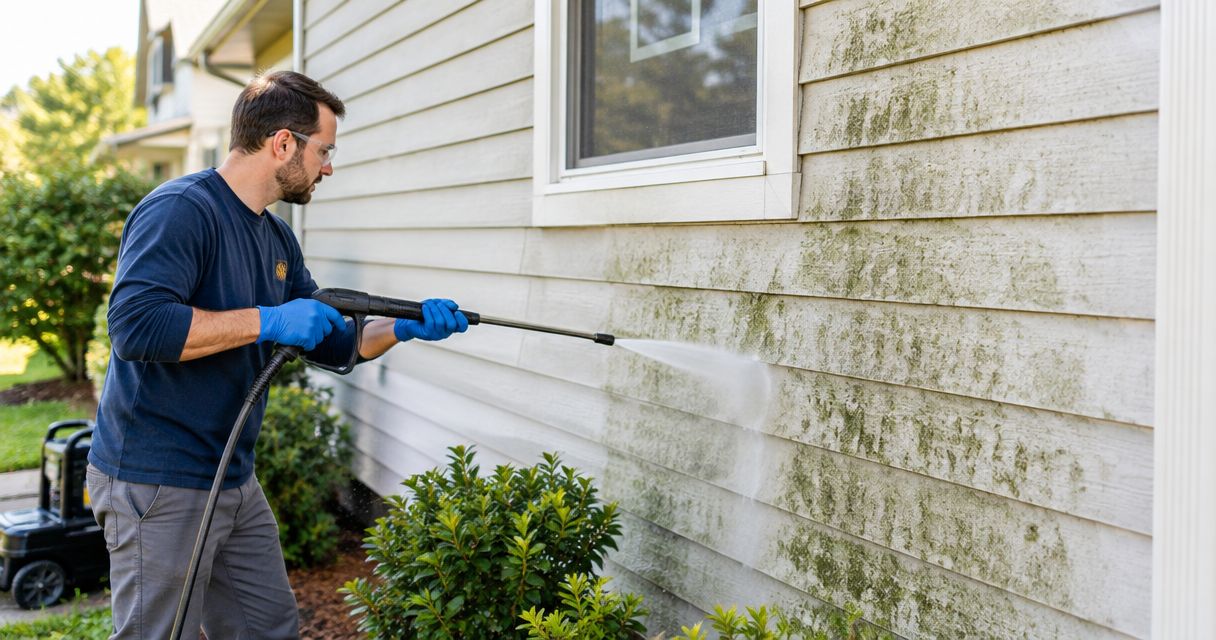
Green patches, black streaks, and dark spotting do not automatically mean the same problem. Algae, mildew, accumulated dirt, and mineral staining need different treatment decisions. Color alone does not identify the organism or tell you which cleaner belongs on the surface.
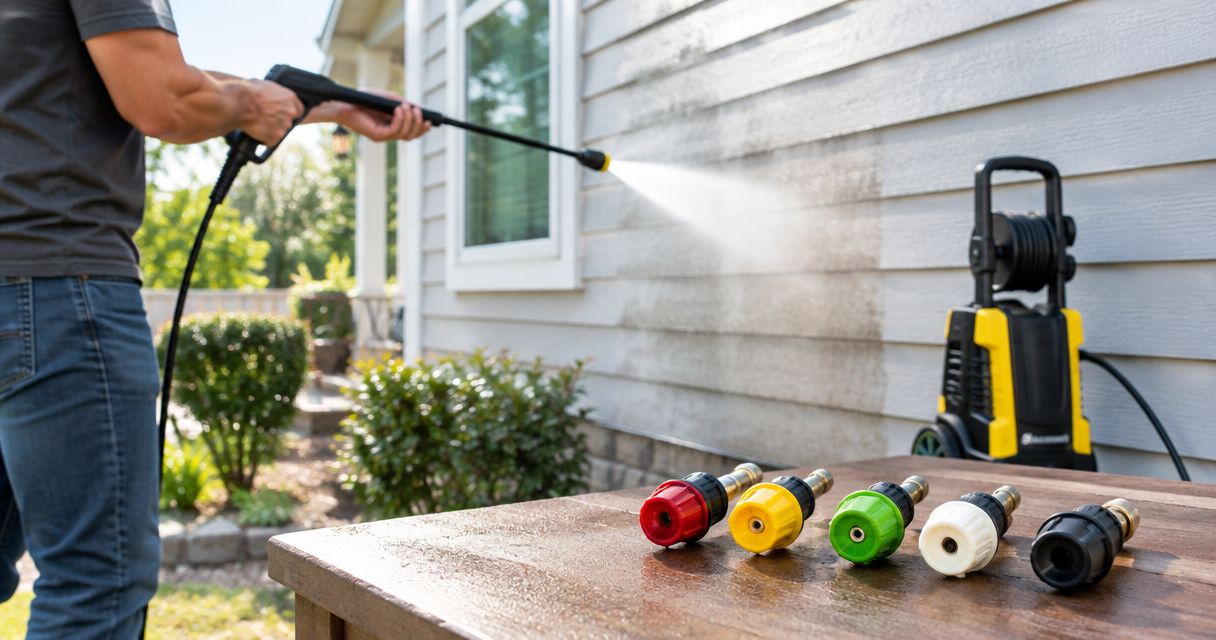
A cleaner that addresses organic growth can still damage an incompatible finish. Pressure adds another variable: a suitable cleaning solution does not make an aggressive nozzle suitable for siding, roof shingles, or deteriorating mortar.
For properties in Troup and Coweta counties, start with the material and its condition. Check shaded walls, porch surfaces, roof areas, and commercial entrances separately rather than treating the entire property as one cleaning job.
What makes the best exterior mold and mildew remover?
Use these criteria to evaluate exterior cleaners in 2026 before choosing a product or contractor:
- Surface compatibility: The label or material manufacturer's instructions must support the intended use. Painted wood, vinyl, masonry, and asphalt shingles are not interchangeable.
- Cleaning purpose: Distinguish a cleaner that removes ordinary soil from a product labeled to address mold or mildew. Do not assume every exterior wash has the same function.
- Application control: Look for clear directions covering application, contact time, rinsing, and any restrictions. Stronger concentration is not a substitute for following directions.
- Property protection: Plan for landscaping, nearby metal, outdoor furniture, electrical fixtures, and runoff before treatment starts.
- Honest limits: Cleaning cannot repair failed paint, damaged mortar, leaks, or decayed wood. Some discoloration improves without disappearing completely.
Exterior cleaning options at a glance
These 5 options cover different decisions, not interchangeable bottles. The 2026 comparison ranks each by its intended use; it does not claim that every cleaner within a category performs equally.
| Option | Best for | Standout feature | Key limitation |
|---|---|---|---|
| Professional surface-matched soft washing | Widespread growth on house exteriors | Combines cleaning chemistry with low-pressure application | Requires surface inspection and a defined scope |
| Label-approved sodium hypochlorite cleaner | Compatible masonry with organic staining | Chlorine-based chemistry used in exterior cleaning | Can harm plants and incompatible materials |
| Label-approved peroxide cleaner | Small areas where the label supports the finish | Provides a different active-ingredient option | Compatibility and effectiveness remain product-specific |
| Exterior detergent | Routine cleaning of light dirt and surface soil | Focuses on washing away ordinary contamination | Is not automatically a mold or mildew treatment |
| Professional roof-specific soft washing | Organic staining on suitable roofing | Matches treatment to roofing instructions | Does not correct leaks or deteriorated roofing |
1. Professional soft washing: best for widespread siding growth
Professional surface-matched soft washing uses cleaning chemistry and low-pressure application rather than relying on force alone. It is the first option to consider when growth covers several walls, reaches upper stories, or sits beside vulnerable landscaping.
Southern Style Soft Wash offers house exterior cleaning, but the right treatment still starts with identifying the siding and inspecting its condition. Ask how the contractor handles loose paint, damaged joints, exposed electrical fixtures, and nearby plants. A service name alone does not establish a protection plan.
Professional soft washing pros:
- Reduces reliance on aggressive pressure for organic growth.
- Allows treatment decisions to account for different exterior materials.
- Gives difficult access and property protection a place in the work plan.
Professional soft washing cons:
- Requires scheduling and a clear agreement about included surfaces.
- Cannot restore damaged siding or failing finishes.
- Does not eliminate every risk of discoloration, water intrusion, or plant injury.
Best for: Homeowners and commercial property owners with widespread exterior growth or complicated access.
Verdict: Buy a surface-specific cleaning service, not a promise that one method cleans everything.
2. Sodium hypochlorite cleaner: best for compatible masonry
Sodium hypochlorite is the chlorine-based active ingredient found in bleach and many exterior cleaning solutions. A product labeled for the intended masonry surface can be an option for organic staining on suitable concrete or other approved materials.
The product label controls the use. Decorative finishes, sealers, nearby metal, and deteriorated mortar can change the decision. Cleaning a sound concrete walkway is not the same task as treating painted masonry or fragile brick steps.
Sodium hypochlorite cleaner pros:
- Provides an established chemistry option for organic exterior contamination.
- Comes with product-specific directions when sold as an exterior cleaner.
- Can support cleaning without making high pressure the primary treatment.
Sodium hypochlorite cleaner cons:
- Exposure can injure landscaping and affect incompatible finishes or metals.
- Requires careful handling, label-directed protection, and runoff planning.
- Does not solve every mineral stain or underlying moisture problem.
Never mix sodium hypochlorite with acids, ammonia, or other cleaning products. Dangerous gases can result. Use only the mixtures and application methods expressly permitted by the product label.
Best for: Organic staining on accessible masonry that the product label explicitly permits.
Verdict: Buy only after confirming the exact surface and its finish are approved uses.
3. Peroxide cleaner: best for label-approved spot treatment
Peroxide-based exterior cleaners provide another chemistry category to evaluate. Consider one for a small, accessible area only when its label supports both the material and the cleaning task.
Do not interpret a different active ingredient as proof that a cleaner is harmless. Peroxide products vary in formulation, and the word peroxide does not establish paint compatibility, plant safety, or suitability for a particular stain.
Peroxide cleaner pros:
- Offers an alternative chemistry to compare against chlorine-based products.
- Can fit a limited spot-cleaning task when the label permits it.
- Allows a small-area compatibility check before broader treatment.
Peroxide cleaner cons:
- Performance depends on the actual formulation and contamination.
- Can affect incompatible materials or finishes.
- Is not a universal substitute for roof cleaning or widespread exterior treatment.
Read the directions for contact time and rinsing instead of borrowing instructions from another cleaner. An inconspicuous test checks the finish response; it does not prove that every part of the wall will react identically.
Best for: Small exterior areas with clear product-label approval and manageable access.
Verdict: Hold until the label confirms the surface and the intended treatment.
4. Exterior detergent: best for routine dirt removal
An exterior detergent helps loosen ordinary dirt and surface soil so washing can remove them. Choose this category when the job is routine cleaning rather than confirmed treatment of established mold or mildew.
That distinction matters. A dirty porch rail does not automatically need stronger chemistry, but a detergent without a relevant treatment claim should not be presented as a mold-killing product.
Exterior detergent pros:
- Keeps ordinary cleaning separate from specialty treatment.
- Can suit accessible maintenance tasks on label-approved surfaces.
- Supports a measured approach instead of starting with the strongest chemical.
Exterior detergent cons:
- Is not automatically effective against established organic growth.
- Still requires compatibility checks and label-directed rinsing.
- Cannot resolve recurring wet conditions or permanent staining.
Use appropriate tools and surface-safe pressure. Scrubbing harder or moving a pressure nozzle closer does not correct a mismatch between the cleaner and the task.
Best for: Light dirt and routine maintenance on accessible exterior surfaces.
Verdict: Buy for ordinary soil; skip it as a substitute for a needed mold or mildew treatment.
5. Roof-specific soft washing: best for organic roof staining
Roof cleaning belongs in a separate decision category because roofing materials have their own cleaning restrictions. For asphalt shingles, follow the roofing manufacturer's guidance rather than treating the roof like a driveway.
Southern Style Soft Wash offers roof cleaning alongside its other exterior services. Ask about the proposed chemistry, low-pressure application, runoff control, and how the contractor distinguishes organic staining from roof deterioration.
Roof-specific soft washing pros:
- Keeps roofing requirements separate from siding and concrete cleaning.
- Avoids using aggressive pressure as the default for asphalt shingles.
- Makes access, runoff, and nearby landscaping part of the discussion.
Roof-specific soft washing cons:
- Roof access creates a separate safety concern.
- Cleaning does not repair leaks, damaged shingles, or flashing defects.
- Some visible discoloration can remain after appropriate treatment.
Best for: Property owners dealing with organic staining on roofing suitable for cleaning.
Verdict: Buy a roof-specific assessment; skip aggressive pressure washing on asphalt shingles.
How we ranked these options
The ranking prioritizes surface compatibility, cleaning purpose, application control, property protection, and realistic outcomes. Professional soft washing is the default for widespread exterior growth because the task involves more than choosing an active ingredient.
This is a method-based buying guide, not a laboratory comparison of named retail products. A cleaner earns consideration only when its directions fit your material and contamination; the category name alone is not enough.
Match the method to the surface
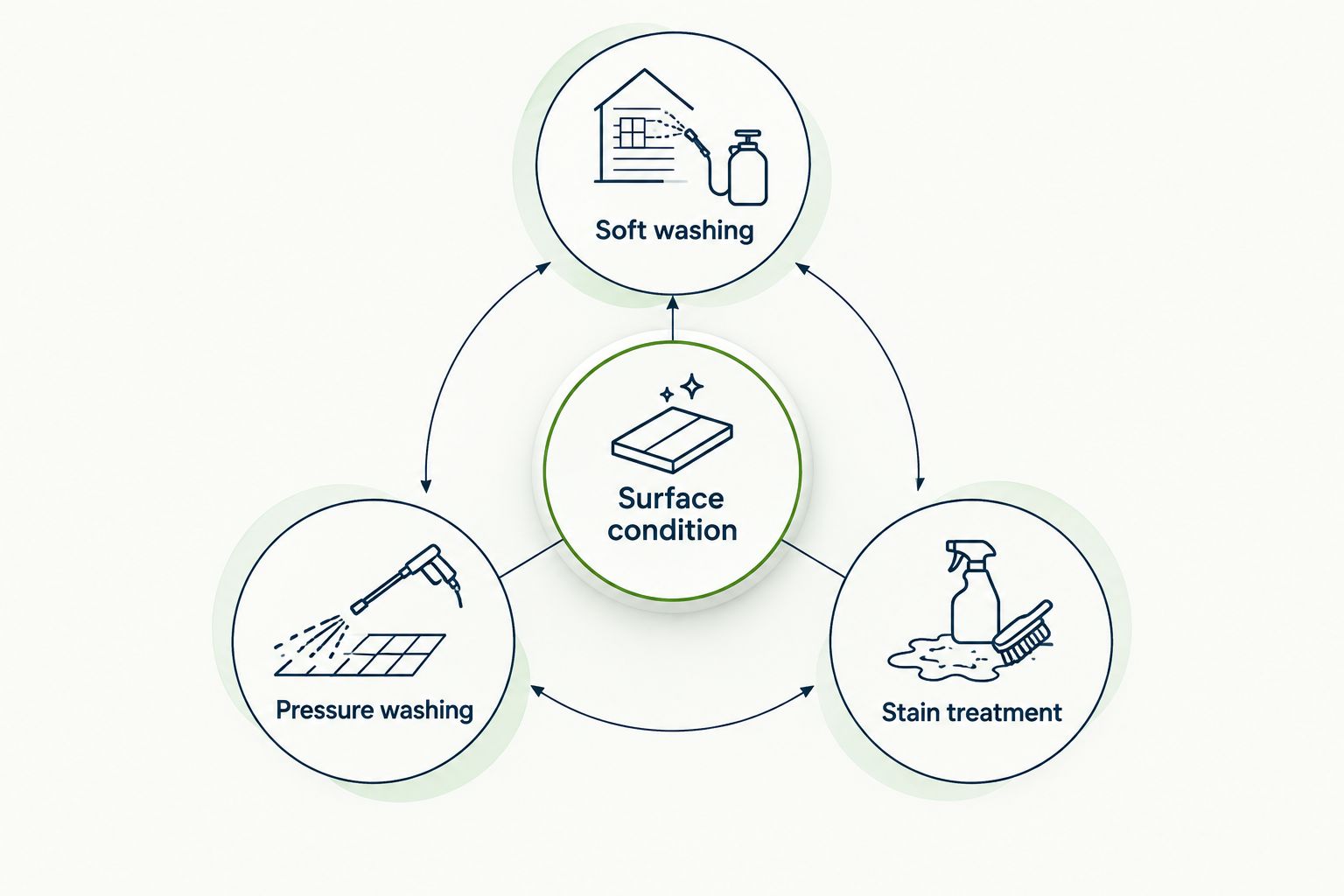
Your 2026 cleaning plan should distinguish 3 methods before anyone starts work:
- Soft washing: Low-pressure application with suitable chemistry for the surface and contamination.
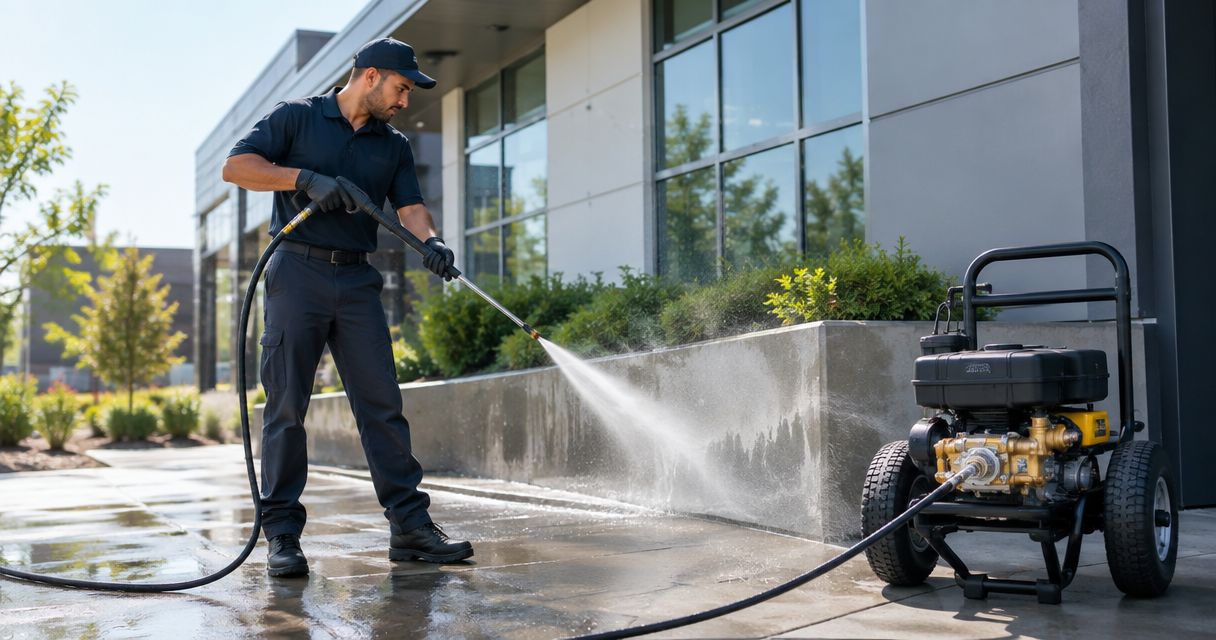
- Pressure washing: Mechanical cleaning with pressure matched to the material and its condition, commonly considered for suitable concrete.
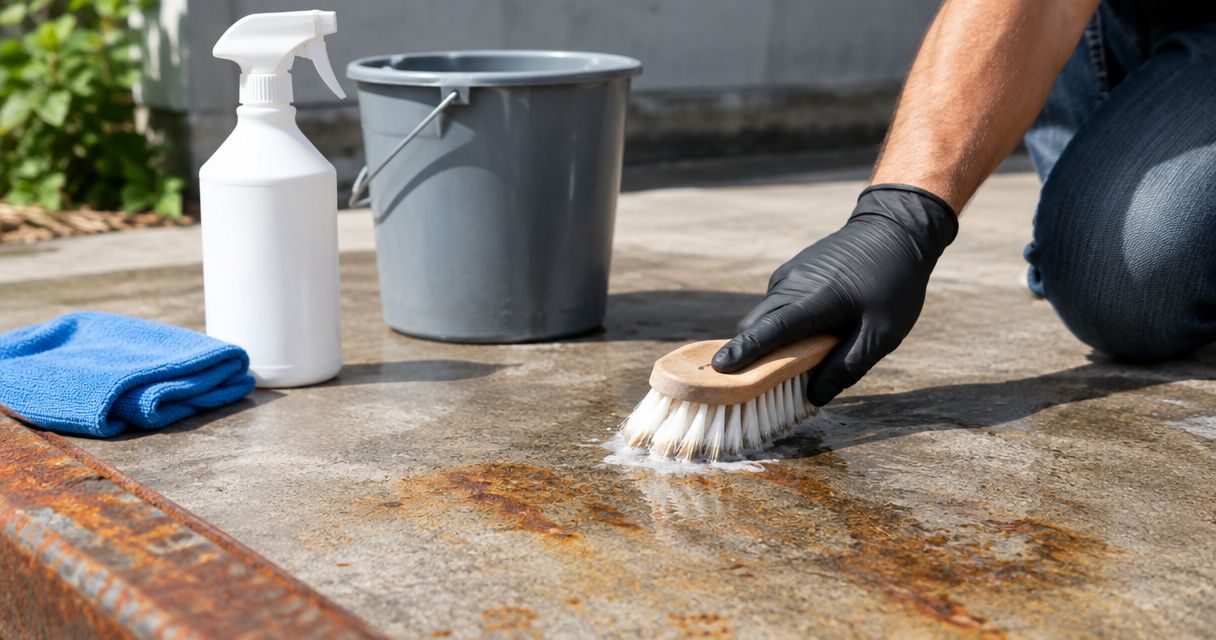
- Stain treatment: Targeted chemistry for a specific stain, such as rust or mineral deposits, rather than assuming every mark is organic growth.
Red clay residue and rust staining need a different assessment from mildew. Do not keep increasing bleach concentration or pressure when the mark does not respond. Stop and identify what remains before adding another treatment.
For commercial properties, divide the work by surface: building exterior, entrance concrete, roof, and specialty stains. A uniform-looking property can still require several cleaning methods.
Protect the property before treatment
Before exterior cleaning in 2026, ask these 4 questions: What needs protection? Where will runoff travel? What must move? What damage already exists?
Landscaping: Discuss pre-wetting, controlled application, and rinsing where appropriate. A suitable neutralizer can be part of a professional protection plan when chemistry and site conditions call for it; it does not replace limiting exposure or following directions.
Fixtures and finishes: Identify exposed outlets, damaged seals, loose paint, nearby metals, and delicate decorations. Avoid directing water into openings. Photograph existing damage so cleaning and repair needs remain separate.
Furniture and access: Decide who will move porch furniture, planters, and other obstacles before the visit. Older homeowners should not need to lift heavy items to prepare; request assistance in advance and confirm what the service includes.
People and runoff: Keep children and pets away from the treatment area according to product directions. Discuss drainage, neighboring property, and any areas where wash water could collect.
No responsible contractor can promise zero risk. A useful protection plan names the exposures and explains how the work will address them.
Which exterior cleaner should you choose?
Choose professional surface-matched soft washing for widespread organic growth; choose a labeled retail cleaner only for a compatible, accessible task. Detergent belongs with ordinary soil, roof cleaning needs roofing-specific guidance, and mineral stains need their own diagnosis.
For a 2026 service inquiry, describe each surface separately. Mention whether the problem is on siding, roofing, concrete, or a specialty stain area, and disclose damaged finishes or recurring moisture.
Discuss your exterior cleaning needs
Identify the surfaces, staining, and access concerns before choosing a cleaning method.
FAQ
What's the best mold and mildew remover for a house exterior?
The best mold and mildew remover for a house exterior is one approved for the specific material and cleaning task. For widespread growth, professional surface-matched soft washing is the recommended starting point; accessible spot cleaning requires product-label checks.
Is bleach better than a peroxide exterior cleaner?
Neither bleach nor a peroxide cleaner is better for every exterior surface. Compare the actual product labels, approved materials, application directions, and intended contamination rather than choosing by active ingredient alone.
Can I pressure wash mold off vinyl siding?
Do not treat high pressure as the default for cleaning vinyl siding. Follow the siding manufacturer's instructions and avoid forcing water behind panels or into openings; suitable chemistry and controlled rinsing address a different task from mechanical force.
Will exterior cleaning remove every black or green stain?
Exterior cleaning does not guarantee complete removal of every black or green stain. Organic growth, mineral deposits, damaged finishes, and permanent discoloration can look similar, so the remaining mark needs identification rather than repeated aggressive treatment.
How do I protect plants during exterior cleaning?
Protect plants by limiting chemical exposure and using appropriate pre-wetting and rinsing procedures. Discuss runoff and any suitable neutralizer with the contractor; these precautions do not make chemical exposure harmless.
Should I use the same cleaner on my roof and driveway?
Do not assume the same cleaner and application method suit a roof and driveway. Roofing instructions, concrete condition, finishes, and runoff risks require separate decisions, even when organic staining appears on both surfaces.
Who provides house, roof, and concrete cleaning around LaGrange?
Southern Style Soft Wash offers house, roof, concrete, and specialty stain cleaning for residential and commercial property owners in LaGrange, Newnan, Valley, and surrounding West Georgia and East Alabama areas. Describe the affected surfaces and access concerns when discussing the work.
One last thing
Photograph a recurring stain before cleaning, then photograph it again when it returns. Include the nearby gutter, downspout, shaded corner, or irrigation spray in the frame. Cleaning addresses the surface contamination; those photographs help you discuss a recurring moisture source without assuming that a stronger cleaner is the answer.